02/02/2026 | han.vo@elsanow.io


In a global industry built on precision, English for Aviation functions as a core operational requirement rather than a soft skill. Aviation depends on shared understanding across borders, roles, and accents. Small misunderstandings can escalate quickly in high-pressure environments. For HR managers, training leaders, and safety or compliance officers, language capability directly affects safety outcomes, regulatory adherence, and operational reliability.
International aviation regulation places English for Aviation firmly within the safety framework. ICAO mandates English as the common language for international aeronautical communication and defines minimum language proficiency levels. These standards exist because standardized phraseology cannot cover every abnormal or emergency situation (ICAO). National authorities reinforce this approach, as FAA guidance aligns licensing and operational approval with ICAO language requirements (FAA).
Kiểm tra phát âm với bài tập sau:

English for Aviation and Safety, Compliance, and Risk Exposure

Safety data shows why English for Aviation remains critical. A review of major aviation accidents found that 30% of the 20 deadliest commercial crashes involved communication errors. The same study linked 55% of accidents to broader human factors, where language often played a supporting role (DergiPark). These failures tend to surface under stress, high workload, or time pressure.
The role of English for Aviation extends beyond rare accidents into daily operations. A statistical analysis of aviation incidents related to crew communication problems reported that around 80% of cases occurred in commercial flights (ESREL 2023 Proceedings). Many of these incidents arose during routine phases of flight, which shows that language risk persists even in normal operations.
Strong English for Aviation capability also supports regulatory compliance. Misunderstood instructions, unclear readbacks, or delayed clarification can lead to deviations from standard operating procedures. ICAO continues to stress consistent language proficiency implementation because compliance relies on accurate understanding and response in real operating conditions (ICAO).
English for Aviation and Customer Experience, Operations, and Efficiency
Passenger perception often reflects the quality of English for Aviation used during service interactions. During delays, cancellations, or irregular operations, travelers rely on clear explanations and guidance. Oversight bodies such as the U.S. Department of Transportation publish Air Travel Consumer Reports that track complaints and service performance across airlines (U.S. DOT). Clear communication often determines whether issues resolve quickly or escalate.
Operational efficiency also depends on English for Aviation across teams. Flight crews, cabin staff, ground handling, and maintenance teams rely on precise handovers and shared situational awareness. Research on communication errors shows that misunderstandings frequently cause rework, delays, and coordination failures (DergiPark). Over time, these inefficiencies increase cost and affect on-time performance.
English for Aviation Training as a Business and Safety Capability
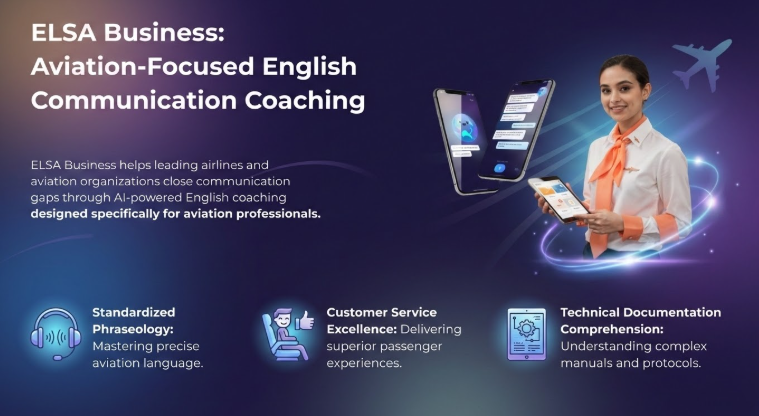
Effective English for Aviation programs focus on job-specific communication rather than general language theory. High-impact training builds discipline in standardized phraseology, strengthens plain-English escalation skills, improves listening comprehension across accents, and supports customer-facing communication during disruptions. ICAO language guidance defines proficiency as the ability to interact and comprehend under operational pressure, not simply knowledge of vocabulary (ICAO).
To scale across large or distributed teams, English for Aviation training must fit operational realities. AI-enabled platforms such as ELSA for Business support targeted English coaching through assessment, personalized practice, and progress tracking aligned with real workplace scenarios (ELSA for Business). HR and compliance leaders gain visibility into improvement while maintaining consistent standards.
Organizations achieve the greatest impact when they treat English for Aviation as a continuous operational capability. Integrating language development into safety management systems, recurrent training, and performance reviews strengthens long-term outcomes. A structured overview of aviation-focused English communication programs is available through the ELSA for Business training proposal page, outlining how role-based coaching supports safety, efficiency, and compliance goals.