13/01/2026 | Huong Vu


Universities aim to build employable graduates, yet many students still lack workplace English communication skills. This gap raises questions about what classrooms still miss.

English language skills in today’s labor market
As higher education evolves, the gap between workplace English vs academic English has become increasingly visible. Employers now expect graduates to communicate clearly and effectively in real work situations, not only demonstrate academic knowledge. However, many students still leave university with strong academic English but limited exposure to workplace English skills needed for entry-level roles.
Kiểm tra phát âm với bài tập sau:

According to the World Economic Forum (2020), skills such as problem-solving, communication, and adaptability are essential for future employment. Yet, the difference between workplace English and academic English continues to create a skills gap between what students learn in classrooms and what employers expect on the job.
Are universities preparing students with competent English for the Workplace yet?
In response, universities worldwide have introduced industry-engaged teaching, work-based learning, and employability-focused curricula. Many institutions in Southeast Asia have taken steps to improve graduate readiness. However, these efforts do not always address the core challenge of workplace English vs academic English.
As a result, students may graduate with solid theoretical knowledge but limited experience using English in professional contexts. This gap slows their transition from classroom to workplace and affects early career performance.
Workplace English vs Academic English: The Readiness Gap
According to a recent research by International Data Corporation (IDC), Asia-based businesses that aiming to go global must find a way to plug the communications gap, where:

65% believe English proficiency is a key benefit for successful global expansion.
64% believe higher English proficiency inspires professional growth of employees.
99% of Asia-based businesses still feel their employees need upskilling in English proficiency.
The survey shows that over 80% of Asia-based businesses see a positive business impact from English communication skills in customer-facing roles. As a result, organizations across industries report measurable business outcomes from stronger workplace English skills, including:
- IT, Software and Consulting
- Manufacturing
- Financial Services
- Hospitality and FMCG
- Education
Despite ongoing reforms, higher education often overlooks practical communication skills. Academic English focuses on structured essays, formal vocabulary, and theoretical discussions: skills that are vital in a classroom setting.
However, the demands of the workplace are very different. In professional environments, English communication must be clear, concise, adaptive, and often fast-paced. Employees need to negotiate, solve problems, collaborate in teams, present ideas, and respond to real-time questions, abilities that academic English courses rarely cover.
Although English is a compulsory subject in many countries, academic English alone does not meet employer needs. Consequently, employers report that graduates lack essential soft skills such as professional writing, interpersonal communication, and responsiveness in workplace settings.
Evidence from employers and research
Studies have shown that graduates who excel in academic English can still struggle with job interviews, workplace presentations, or client meetings because these situations require practical speaking and listening skills, not just textbook knowledge.
Graduates often find it difficult to express ideas clearly, respond promptly, or work effectively in multicultural teams. According to the ETS Human Progress Report (2025), 84% of respondents consider communication essential for work. Yet only 65% of new hires receive assessment in this area, leaving a 20% gap tied closely to workplace English skills.
This gap highlights a clear disconnect between what graduates are taught and what the workplace actually demands. While academic English builds foundational knowledge, it rarely prepares learners for spontaneous discussions, practical problem-solving, or industry-specific communication. To bridge this gap, English learning must move beyond theory and focus on how language is used in real work situations.
Real workplace readiness comes from applied English practice
To truly bridge the gap between classroom learning and workplace demands, English education must go beyond traditional academic exercises and focus on skills that translate directly to real job settings—skills that come from applied English practice:
- Real-world scenarios: Practicing workplace conversations builds confidence for meetings, presentations, and cross-functional teamwork.
- Immediate feedback: Applied speaking tools let learners recognize and correct mistakes, preparing them for authentic, unscripted situations.
- Industry-specific language: Each sector uses unique terms and phrases that academic English does not address.
Together, these elements help learners develop not just linguistic accuracy, but also the confidence and flexibility needed to thrive in a professional environment. When students are exposed to real-world scenarios and receive immediate, actionable feedback, they build the ability to think on their feet and communicate ideas clearly: whether in meetings, presentations, or everyday team discussions.
Moreover, learning industry-specific language prepares graduates to seamlessly integrate into specialized fields, where knowing the right terminology and communication style is often as important as technical expertise. By incorporating applied English practice into their training, students are empowered to participate actively in workplace conversations, navigate multicultural teams, and tackle unexpected challenges with poise.
This approach bridges the gap between academic preparation and workplace reality, ensuring that graduates not only meet employers’ expectations but also make a meaningful impact from their very first day on the job. As the demands of the workforce continue to evolve, the ability to use English confidently and contextually will remain a decisive factor in career success.
Early Workplace English Training: Measurable Results and Long-Term Impact
Since 2023, Dong A University (Da Nang, Vietnam) has implemented ELSA’s solution to strengthen workplace English skills beyond academic English, starting with freshmen through a pronunciation module. Using AI-powered speech recognition, students improve pronunciation and build a foundation in standard, practical English from their first year.
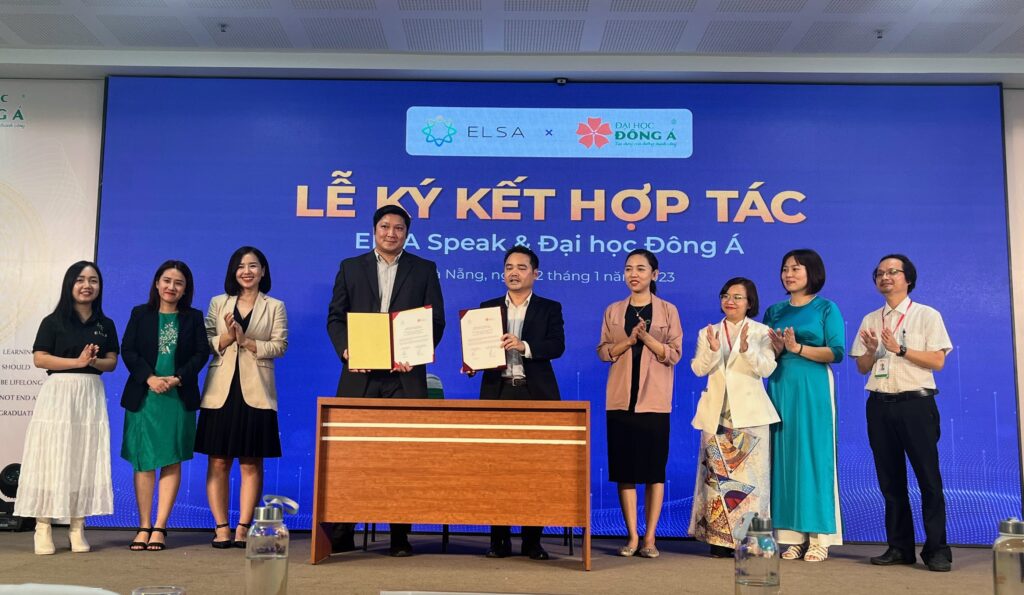
ELSA and Dong A University signing ceremony in 2023
Over three consecutive years (2023–2025), nearly 10,000 students at Dong A University participated in the program. As a result, the average English Proficiency Score (EPS) increased from 50% to 72%, demonstrating measurable improvement in English proficiency aligned with workplace needs.

ELSA workshop at Dong A University in 2025
Looking ahead to 2025, the university will expand ELSA into additional modules. This expansion allows students to practice Business English throughout their academic journey, not only in isolated language courses. Moreover, it supports continuous language development that aligns more closely with real-world communication demands.
To explore how AI can help bridge this skills gap, schools can request a demo of ELSA’s solution and see the impact of an AI-powered English program in practice here.
ELSA School
References:
World Economic Forum. (2020, October 20). The Future of Jobs Report 2020. https://www3.weforum.org/docs/WEF_Future_of_Jobs_2020.pdf
Educational Testing Service (ETS). (2025). 2025 ETS Human Progress Report (HR Edition): The Skills Advantage: Unlocking Talent Acquisition and Retention. https://www.ets.org/pdfs/human-progress-report/2025-human-progress-report-hr-edition.pdf