26/03/2026 | Admin


Hiểu và sử dụng thành thạo Word Form chính là “chìa khóa nâng cấp” vốn từ vựng và khả năng diễn đạt của bạn trong tiếng Anh. Cùng ELSA Speak sẽ giúp bạn khám phá toàn bộ kiến thức từ cơ bản đến nâng cao kèm bài tập thực hành nhé!
| Nội dung chính cần nắm |
| Word Form (dạng từ) là kỹ năng biến đổi một từ gốc thành các dạng khác nhau để dùng đúng trong câu như: danh từ, động từ, tính từ, trạng từ. Bạn có thể tạo Word Form bằng cách thêm tiền tố, hậu tố hoặc điều chỉnh cấu trúc từ: – Danh từ: -tion, -ment, -ness, -er…. (kết hợp un-, dis-…) – Động từ: -ize, -ify, -ate… (kết hợp en-, over-…) – Tính từ: -ful, -less, -ous… (kết hợp un-, im-, in-…) – Trạng từ: thường thêm -ly, -ward… |
Word Form là gì?
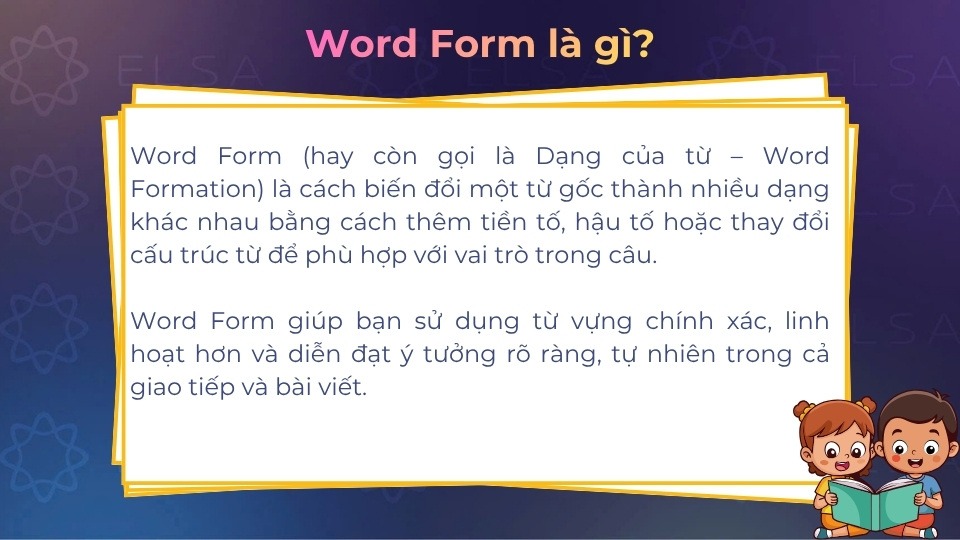
Word Form (hay còn gọi là Dạng của từ – Word Formation) là cách biến đổi một từ gốc thành nhiều dạng khác nhau bằng cách thêm tiền tố, hậu tố hoặc thay đổi cấu trúc từ để phù hợp với vai trò trong câu.
Kiểm tra phát âm với bài tập sau:

Word Form giúp bạn sử dụng từ vựng chính xác, linh hoạt hơn và diễn đạt ý tưởng rõ ràng, tự nhiên trong cả giao tiếp và bài viết.
Ví dụ:
- Danh từ: creation (sự sáng tạo), creator (người sáng tạo)
- Động từ: create (tạo ra)
- Tính từ: creative (sáng tạo)
- Trạng từ: creatively (một cách sáng tạo)
Word Form là gì?
Cách thành lập Word Form dạng động từ
Vị trí của Word Form dạng động từ
Động từ đóng vai trò trung tâm trong câu, thường đứng sau chủ ngữ hoặc trước trạng từ trong câu để diễn tả hành động hoặc trạng thái của đối tượng được đề cập.
Ví dụ:
- He reads books every day. (Anh ấy đọc sách mỗi ngày.)
- She runs quickly to catch the bus. (Cô ấy chạy nhanh để bắt xe buýt.)
Một số cấu trúc Word Form dạng động từ
Word Form động từ thường chứa các hậu tố sau:
– ate: activate, communicate, collaborate, delegate, celebrate,…
– en: harden, shorten, strengthen, sweeten,…
– ify: modify, simplify, solidify, diversify, identify,…
– ise/-ize: symbolize, specialize, minimize, visualize,…
Ngoài ra, tiền tố cũng có thể được thêm vào các danh từ, tính từ hoặc động từ để tạo thành động từ mới với công thức Word Form như sau:
| Cấu trúc | Ví dụ |
| En- + Noun/Adjective/Verb | Large → enlarge (lớn thêm) Rich → enrich (làm giàu lên) |
| Over- + Verb | Charge → overcharge (tính phí quá mức) Estimate → overestimate (đánh giá cao quá mức) |
| Under- + Verb | Perform → underperform (thể hiện kém) Report → underreport (báo cáo không đầy đủ) |
| Out + intransitive Verb → transitive Verb | Grow → outgrow (lớn hơn) Match → outmatch (vượt trội hơn) |
Cách thành lập Word Form dạng danh từ
Vị trí của Word Form dạng danh từ
Word Form dạng danh từ có thể đảm nhận nhiều vai trò khác nhau trong câu, giúp làm rõ ý nghĩa và chức năng của chúng:
| Vị trí của danh từ | Ví dụ |
| Chủ ngữ trong câu | This book is interesting.(Quyển sách này thật thú vị.) |
| Tân ngữ, đứng sau động từ | He is reading a novel.(Anh ấy đang đọc tiểu thuyết.) |
| Đứng sau tính từ sở hữu | My brother works hard.(Anh trai của tôi làm việc chăm chỉ.) |
| Bổ ngữ trong câu | He is a musician.(Anh ấy là một nhạc sĩ.) |
| Đứng sau mạo từ hoặc từ chỉ định (a, an, the, this, that, these, those, each, every, etc.) | This book is an interesting book.(Cuốn sách này thực sự thú vị.) |
| Đứng sau giới từ hoặc cụm giới từ (in, on, at, about, of, with, under, etc.) | The children are playing in the park. (Các trẻ em đang chơi trong công viên.) |
Một số cấu trúc dạng Word Form dạng danh từ
Thêm hậu tố vào động từ
| Cấu trúc | Ví dụ |
| V + -tion/-ation/-sion | Create → creation (sự sáng tạo) Decide → decision (sự quyết định) |
| V + -ment | Enjoy → enjoyment (sự hưởng thụ) Develop → development (sự phát triển) |
| V + -ance/-ence | Tolerate → tolerance (sự khoan dung) Exist → existence (sự tồn tại) |
| V + -er/-or (chỉ người hoặc vật) | Write → writer (nhà văn) Act → actor (diễn viên) |
| V + -ant/-ee (chỉ người) | Participate → participant (người tham gia) Interview → interviewee (người được phỏng vấn) |
| V + -age | Pack → package (bưu kiện) Waste → wastage (sự phí phạm) |
| V + -ing | Cook → cooking (việc nấu ăn) Draw → drawing (vẽ) |
Thêm hậu tố vào tính từ
| Cấu trúc | Ví dụ |
| Adj + -ity | Active → activity (hoạt động) Responsible → responsibility (trách nhiệm) |
| Adj + -ness | Sad → sadness (nỗi buồn) Bright → brightness (độ sáng) |
| Adj + -ism (chỉ chế độ, chủ nghĩa) | Optimism → optimism (tính lạc quan) Capital → capitalism (chủ nghĩa tư bản) |
Thêm hậu tố vào danh từ
| Công thức | Ví dụ |
| N + -ship (chỉ tình trạng, mối quan hệ) | Leader → leadership (sự lãnh đạo) Partner → partnership (sự hợp tác) |
| N + -ism (chỉ chế độ, chủ nghĩa) | Race → racism (chủ nghĩa phân biệt chủng tộc) |
| N + -ist (chỉ người) | Art → artist (nghệ sĩ) Journal → journalist (nhà báo) |
Thêm tiền tố vào trước danh từ
| Công thức | Ví dụ |
| Super- + N (rất, vượt trội) | Hero → superhero (siêu anh hùng) |
| Under- + N (dưới, thiếu) | Ground → underground (tàu điện ngầm) |
| Sur- + N (vượt qua, bên trên) | Face → surface (bề mặt) |
| Sub – + N (ngầm) | Marine → submarine (tàu ngầm) |
Cách thành lập Word Form dạng tính từ
Vị trí của Word Form dạng tính từ
| Vị trí của tính từ | Ví dụ |
| Đứng trước danh từ | The beautiful girl wore the red dress yesterday.(Cô gái xinh đẹp mặc đầm đỏ vào hôm qua.) |
| Đứng sau động từ to be hoặc động từ liên kết (look, seem, sound, feel, taste, smell) | He is handsome.(Anh ấy đẹp trai.) |
Một số cấu trúc Word Form dạng tính từ
Thêm hậu tố vào danh từ
| Công thức | Ví dụ |
| N + -ful | Hope → hopeful (đầy hy vọng) Beauty → beautiful (xinh đẹp) |
| N + -less | Care → careless (bất cẩn) Fear → fearless (không sợ hãi) |
| N + -ly | Man → manly (có vẻ đàn ông) Day → daily (hàng ngày) |
| N + -y | Sun → sunny (nhiều nắng) Rain → rainy (nhiều mưa) |
| N + -ous | Space → spacious (rộng rãi) Danger → dangerous (nguy hiểm) |
| N + -ish | Child → childish (trẻ con) Fool → foolish (ngốc nghếch) |
| N + -en | Gold → golden (làm bằng vàng) Wood → wooden (làm bằng gỗ) |
| N + -al | Culture → cultural (thuộc về văn hóa) Person → personal (thuộc về cá nhân) |
Thêm hậu tố vào động từ
| Công thức | Ví dụ |
| V + -able | Manage → manageable (có thể quản lý được) |
| V + -ible | Access → accessible (có thể truy cập được) |
| V + -tive | Create → creative (sáng tạo) |
Thêm tiền tố vào trước tính từ
| Công thức | Ví dụ |
| Super- + Adj | Human → superhuman (siêu nhân) |
| Under- + Adj | Developed → underdeveloped (kém phát triển) |
| Over- + Adj | Sensitive → oversensitive (nhạy cảm quá mức) |
| Un- + Adj | Clear → unclear (không rõ ràng) |
| In- + Adj | Expensive → inexpensive (rẻ) |
| Im- + Adj | Mature → immature (chưa trưởng thành) |
| Ir- + Adj | Relevant → irrelevant (không liên quan) |
| Il- + Adj | Legal → illegal (bất hợp pháp) |
Có thể bạn quan tâm: Relevant đi với giới từ gì? Cách dùng và các từ đồng nghĩa
Kết hợp danh từ với quá khứ phân từ/hiện tại phân từ
| Công thức | Ví dụ |
| N + past/present participle | Middle + aged → middle-aged (trung niên) |
Kết hợp với well-/ill- và quá khứ phân từ
| Công thức | Ví dụ |
| Well- + past participle | Well + educated → well-educated (có học thức) |
| ill- + past participle | ill + fated → ill-fated (không được may mắn) |
Cách thành lập Word Form dạng trạng từ
Vị trí của Word Form dạng trạng từ
| Vị trí của trạng từ | Ví dụ |
| Trước động từ thường | I often go to school by bike.(Tôi thường đi đến trường bằng xe đạp.) |
| Giữa trợ động từ và động từ chính | He has already finished his homework.(Anh ấy đã hoàn thành bài tập rồi.) |
| Giữa động từ to be/động từ liên kết và tính từ | She is very pretty.(Cô ấy quả là xinh đẹp.) |
| Sau “too” và trước “enough” | He walks too slowly.(Anh ấy đi quá chậm.) |
Một số cấu trúc dạng Word Form dạng trạng từ
| Công thức | Ví dụ |
| Adjective + -ly | Happy → happily (một cách hạnh phúc) Quick → quickly (một cách nhanh chóng) Beautiful → beautifully (một cách đẹp đẽ) |
| Adjective + -ally | Basic → Basically (một cách cơ bản) Ironic → Ironically (một cách mỉa mai) |
Ngoài các quy tắc trên, một số trạng từ có hình thức đặc biệt không tuân theo quy tắc chung:
- Good → Well (một cách tốt)
- Early → Early (một cách sớm)
- Hard → Hard (một cách khó khăn)
Các cặp Word Form dễ gây nhầm lẫn
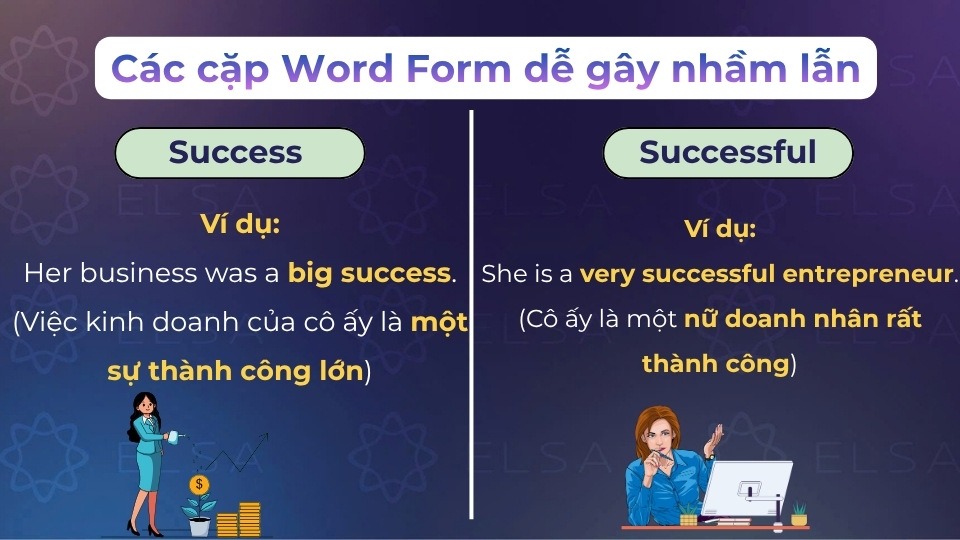
Cặp danh từ và tính từ: success – successful
Success đóng vai trò là danh từ và mang nghĩa là sự thành công. Trong khi đó, successful là một tính từ, mang nghĩa là thành công.
Ví dụ:
- Her business was a big success. (Việc kinh doanh của cô ấy là một sự thành công lớn.)
- She is a very successful entrepreneur. (Cô ấy là một nữ doanh nhân rất thành công.)
Các cặp Word Form dễ gây nhầm lẫn
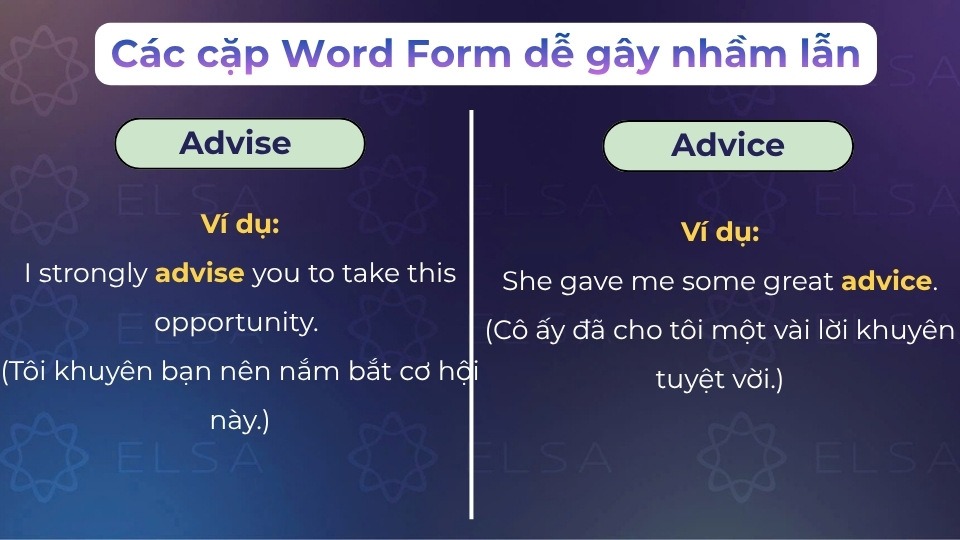
Cặp động từ và danh từ: advise – advice
Advise là một động từ, mang nghĩa là khuyên nhủ, đưa ra lời khuyên. Trong khi đó, advice là một danh từ, mang nghĩa là lời khuyên.
Ví dụ:
- I strongly advise you to take this opportunity. (Tôi khuyên bạn nên nắm bắt cơ hội này.)
- She gave me some great advice.(Cô ấy đã cho tôi một vài lời khuyên tuyệt vời.)
Cặp tính từ và trạng từ dễ nhầm lẫn advise – advice
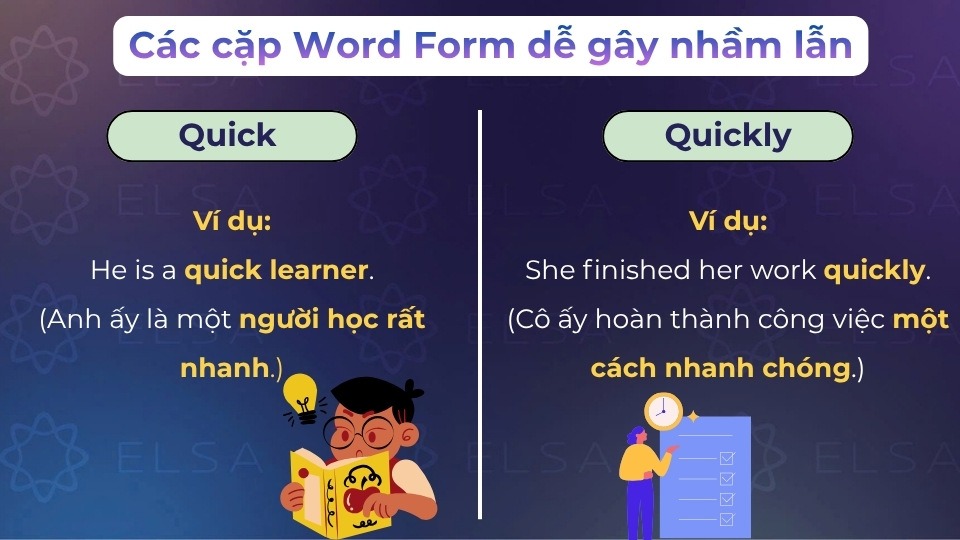
Cặp tính từ và trạng từ: quick – quickly
Quick là một tính từ, dùng để mô tả danh từ (ai/cái gì đó nhanh). Quickly là một trạng từ, dùng để mô tả cách thức hành động diễn ra.
Ví dụ:
- He is a quick learner. (Anh ấy là một người học rất nhanh.)
- She finished her work quickly. (Cô ấy hoàn thành công việc một cách nhanh chóng.)
Cặp tính từ và trạng từ dễ nhầm lẫn quick – quickly
Bảng tổng hợp 10 cặp dễ sai nhất
| Danh từ (Noun) | Động từ (Verb) | Tính từ (Adjective) | Trạng từ (Adverb) |
| success | – | successful | successfully |
| advice | advise | – | – |
| health | – | healthy | healthily |
| beauty | beautify | beautiful | beautifully |
| danger | endanger | dangerous | dangerously |
| comfort | comfort | comfortable | comfortably |
| difficulty | – | difficult | difficultly |
| happiness | – | happy | happily |
| care | care | careful / careless | carefully / carelessly |
| use | use | useful / useless | usefully / uselessly |
Cách làm bài tập word form cực nhanh
Để giải quyết bài tập word form chính xác và tiết kiệm thời gian, bạn có thể áp dụng trực tiếp quy trình 3 bước sau đây:
- Bước 1: Phân tích cấu trúc câu và vị trí ô trống để xác định từ loại cần điền (danh từ, động từ, tính từ hay trạng từ).
- Bước 2: Dựa vào từ gốc, kết hợp với bảng phân tích hậu tố ở trên để biến đổi thành từ loại đã xác định tại bước 1.
- Bước 3: Dịch sơ bộ nghĩa của câu để kiểm tra tính logic, đặc biệt chú ý đến các yếu tố chia số ít/nhiều hoặc tiền tố mang nghĩa phủ định.
Ví dụ áp dụng thực tế:
Đề bài: The new marketing strategy was highly _____. (SUCCESS)
Bước 1: Ô trống đứng sau động từ to be “was” và trạng từ chỉ mức độ “highly”. Theo cấu trúc ngữ pháp, vị trí này bắt buộc phải điền một tính từ.
Bước 2: Từ gốc được cho là “success” (danh từ). Dựa vào quy tắc hậu tố tính từ, ta thêm đuôi “-ful” để tạo thành dạng tính từ tương ứng là successful.
Bước 3: Dịch câu để kiểm tra: “Chiến lược tiếp thị mới đã cực kỳ thành công.” Ngữ nghĩa hoàn toàn logic và phù hợp. Đáp án cuối cùng: successful.
Tổng hợp bảng chuyển đổi Word Form thông dụng
| Danh từ (Noun) | Động từ (Verb) | Tính từ (Adjective) | Trạng từ (Adverb) |
| ability | enable | able | ably |
| acceptance | accept | acceptable | acceptably |
| accident | – | accidental | accidentally |
| achievement | achieve | achievable | – |
| action | act | active | actively |
| addition | add | additional | additionally |
| admiration | admire | admirable | admirably |
| advice | advise | advisable | advisedly |
| agreement | agree | agreeable | agreeably |
| anger | anger | angry | angrily |
| application | apply | applicable | – |
| attraction | attract | attractive | attractively |
| beauty | beautify | beautiful | beautifully |
| belief | believe | believable | believably |
| care | care | careful / careless | carefully / carelessly |
| challenge | challenge | challenging | challengingly |
| change | change | changeable | – |
| choice | choose | choosy | – |
| comfort | comfort | comfortable | comfortably |
| communication | communicate | communicative | communicatively |
| comparison | compare | comparable | comparably |
| competition | compete | competitive | competitively |
| confidence | confide | confident | confidently |
| confusion | confuse | confusing / confused | confusingly |
| courage | encourage | courageous | courageously |
| creation | create | creative | creatively |
| danger | endanger | dangerous | dangerously |
| decision | decide | decisive | decisively |
| decoration | decorate | decorative | decoratively |
| dependence | depend | dependent | dependently |
| description | describe | descriptive | descriptively |
| development | develop | developing / developed | – |
| difference | differ | different | differently |
| difficulty | – | difficult | difficultly |
| direction | direct | directional / direct | directly |
| discussion | discuss | discussable | – |
| education | educate | educational | educationally |
| emotion | – | emotional | emotionally |
| encouragement | encourage | encouraging | encouragingly |
| enjoyment | enjoy | enjoyable | enjoyably |
| environment | – | environmental | environmentally |
| excellence | excel | excellent | excellently |
| experience | experience | experienced | – |
| explanation | explain | explanatory | – |
| failure | fail | failed / failing | – |
| fame | – | famous | famously |
| fear | fear | fearful / fearless | fearfully / fearlessly |
| freedom | free | free | freely |
| friendliness | befriend | friendly / unfriendly | – |
| growth | grow | growing | – |
| happiness | – | happy | happily |
| harm | harm | harmful / harmless | harmfully / harmlessly |
| health | – | healthy / unhealthy | healthily |
| help | help | helpful / helpless | helpfully / helplessly |
| honesty | – | honest | honestly |
| hope | hope | hopeful / hopeless | hopefully / hopelessly |
| importance | – | important | importantly |
| improvement | improve | improved / improvable | – |
| influence | influence | influential | influentially |
| information | inform | informative | informatively |
| inspiration | inspire | inspirational / inspired | inspirationally |
| intelligence | – | intelligent | intelligently |
| interest | interest | interesting / interested | interestingly |
| introduction | introduce | introductory | – |
| invention | invent | inventive | inventively |
| invitation | invite | inviting | invitingly |
| joy | enjoy | joyful / joyless | joyfully / joylessly |
| justice | – | just | justly |
| kindness | – | kind | kindly |
| knowledge | know | knowledgeable | knowledgeably |
| law | outlaw | lawful / unlawful | lawfully / unlawfully |
| leadership | lead | leading | – |
| length | lengthen | long | – |
| life | live | alive / living | – |
| luck | – | lucky / unlucky | luckily / unluckily |
| meaning | mean | meaningful / meaningless | meaningfully |
| movement | move | movable | – |
| necessity | need | necessary / unnecessary | necessarily |
| noise | – | noisy | noisily |
| opinion | opine | opinionated | – |
| pain | pain | painful / painless | painfully / painlessly |
| patience | – | patient / impatient | patiently / impatiently |
| peace | – | peaceful | peacefully |
| perfection | perfect | perfect | perfectly |
| performance | perform | performing | – |
| popularity | popularize | popular | popularly |
| power | empower | powerful / powerless | powerfully / powerlessly |
| preparation | prepare | prepared | – |
| pride | pride | proud | proudly |
| reality | realize | real | really |
| reason | reason | reasonable | reasonably |
| reduction | reduce | reduced | – |
| relation | relate | relative / related | relatively |
| repetition | repeat | repetitive | repeatedly |
| responsibility | – | responsible / irresponsible | responsibly / irresponsibly |
| safety | save | safe | safely |
| satisfaction | satisfy | satisfied / satisfying | satisfactorily |
| science | – | scientific | scientifically |
| shock | shock | shocking / shocked | shockingly |
| strength | strengthen | strong | strongly |
| success | succeed | successful | successfully |
| surprise | surprise | surprising / surprised | surprisingly |
| truth | – | true | truly |
| value | value | valuable / valueless | valuably / valuelessly |
| weakness | weaken | weak | weakly |
| wealth | enrich | wealthy | – |
| wisdom | – | wise | wisely |
| worry | worry | worried / worrisome | worriedly |
Bài tập áp dụng dạng Word Form
Bài tập trắc nghiệm
1. I have a very good _______ with my cousins.
A. relate
B. relating
C. relation
D. relationship
2. I have a big stamp_______.
A. collect
B. collection
C. collector
D. collector
3. My best friend, Linda, has a great ______.
A. person
B. personal
C. personality
D. personally
4. What _______ is he? Vietnamese or Thailand?
A. national
B. nationality
C. nation
D. nationalist
5. She is the only_______of the attack.
A. survivor
B. survive
C. survival
D. survivability
Đáp án:
1. D
2. B
3. C
4. B
5. A
Bài tập tự luận
1. The party ___________ twenty bottles from various parts of the house yesterday. (collect)
2. They enjoy the ___________ atmosphere here. (peace)
3. She will become a ___________. (law)
4. His behaviour was very _________, so the police arrested him. (suspect)
5. There will be a special _______ meeting tomorrow morning at 9a.m, which everyone has to attend. (safe)
Đáp án:
1. collected
2. peaceful
3. lawyer
4. suspicious
5. safety
Xem thêm:
- Động từ to be là gì? Biến thể và cách dùng to be theo các thì
- Kiến thức về tân ngữ trong tiếng Anh đơn giản, dễ hiểu nhất
- Danh động từ (Gerund) trong tiếng Anh là gì? Cách dùng và bài tập áp dụng
Làm chủ Word Form sẽ giúp bạn diễn đạt tiếng Anh chính xác, mạch lạc và tự nhiên hơn. Đồng thời, đừng quên khám phá bài viết khác trong danh mục Từ loại của ELSA Speak để hoàn thiện nền tảng ngôn ngữ của mình nhé.