09/06/2026 | Admin


Bài tập viết lại câu là một dạng bài quan trọng trong chương trình tiếng Anh lớp 9, thường xuất hiện trong các bài kiểm tra hoặc kỳ thi vào lớp 10. Trong bài viết này, ELSA Speak sẽ giúp bạn tổng hợp các bài tập viết lại câu lớp 9 thường gặp kèm đáp án và file PDF, hỗ trợ quá trình ôn luyện của bạn trở nên thuận tiện hơn.
Các dạng bài tập viết lại câu lớp 9 thường gặp
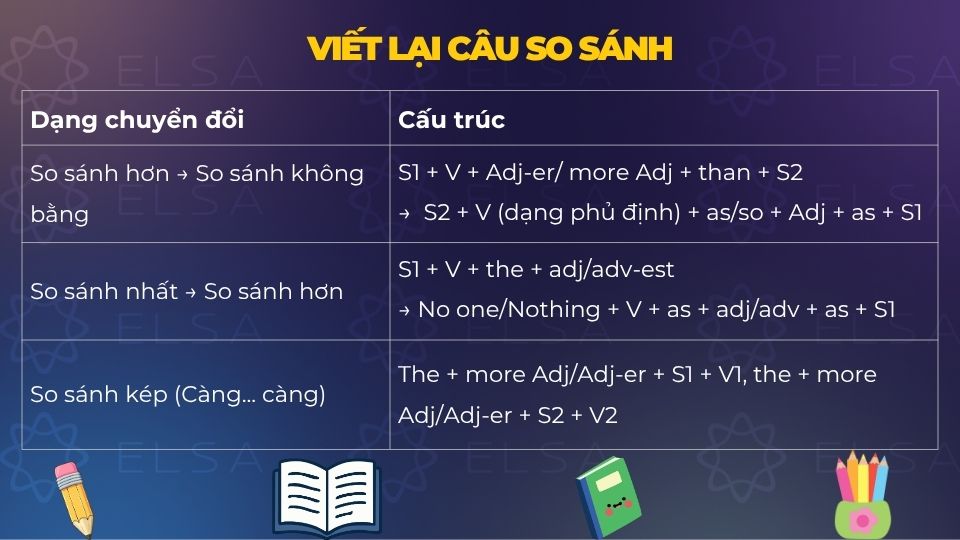
Viết lại câu so sánh
Kiểm tra phát âm với bài tập sau:

Viết lại câu so sánh là một dạng bài tập phổ biến trong chương trình tiếng Anh lớp 9, yêu cầu học sinh chuyển đổi câu nhưng vẫn giữ nguyên ý nghĩa ban đầu. Để làm tốt dạng bài này, bạn cần nắm vững các cấu trúc so sánh bằng, so sánh hơn và so sánh nhất.
| Dạng chuyển đổi | Cấu trúc | Ví dụ |
| So sánh hơn → So sánh không bằng | S1 + V + Adj-er/ more Adj + than + S2 → S2 + V (dạng phủ định) + as/so + Adj + as + S1 | He is taller than me. → I am not as tall as him. (Tôi không cao bằng anh ấy.) |
| So sánh nhất → So sánh hơn | S1 + V + the + adj/adv-est → No one/Nothing + V + as + adj/adv + as + S1 | Lan is the smartest student. → No one in my class is smarter than Lan. (Không ai trong lớp thông minh hơn Lan.) |
| So sánh kép (Càng… càng) | The + more Adj/Adj-er + S1 + V1, the + more Adj/Adj-er + S2 + V2 | If you study hard, you get high marks. → The harder you study, the higher marks you get. (Càng học chăm, bạn càng điểm cao.) |
Viết lại câu tường thuật
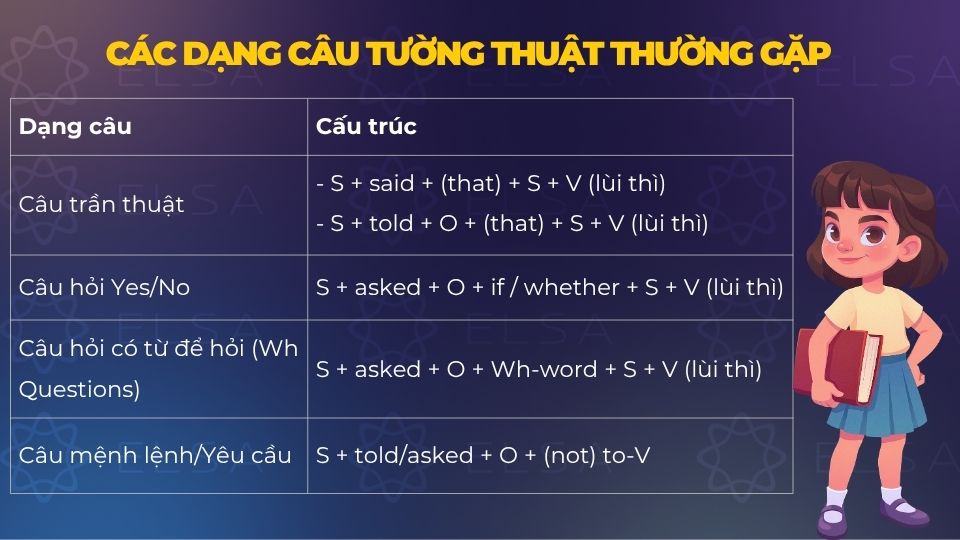
Viết lại câu tường thuật là dạng bài tập yêu cầu chuyển đổi lời nói trực tiếp sang lời nói gián tiếp mà vẫn giữ nguyên nội dung và ý nghĩa của câu.
Khi chuyển từ câu trực tiếp sang câu gián tiếp, cần lưu ý:
- Lùi thì của động từ (nếu động từ tường thuật ở quá khứ).
- Thay đổi đại từ cho phù hợp với người nói và người nghe.
- Thay đổi các trạng từ chỉ thời gian, nơi chốn nếu cần.
Bảng các dạng câu tường thuật thường gặp:
| Dạng câu | Cấu trúc | Ví dụ |
| Câu trần thuật | – S + said + (that) + S + V (lùi thì) – S + told + O + (that) + S + V (lùi thì) | – She said, “I will come to the party tomorrow.” (Cô ấy nói: “Tôi sẽ đến bữa tiệc vào ngày mai.”) – She said that she would come to the party the next day. (Cô ấy nói rằng cô ấy sẽ đến bữa tiệc vào ngày hôm sau.) |
| Câu hỏi Yes/No | S + asked + O + if / whether + S + V (lùi thì) | – Peter asked me, “Are you coming to the party tonight?” (Peter hỏi tôi: “Bạn có đến bữa tiệc tối nay không?”) – Peter asked me if/whether I was coming to the party that night. (Peter hỏi tôi liệu tôi có đến bữa tiệc tối hôm đó không.) |
| Câu hỏi có từ để hỏi (Wh Questions) | S + asked + O + Wh-word + S + V (lùi thì) | – The manager asked, “What time does the meeting start?” (Quản lý hỏi: “Mấy giờ cuộc họp bắt đầu?”) – The manager asked what time the meeting started. (Quản lý hỏi cuộc họp bắt đầu lúc mấy giờ.) |
| Câu mệnh lệnh/Yêu cầu | S + told/asked + O + (not) to-V | The engineer told us, “Don’t touch this button.” (Kỹ sư bảo chúng tôi: “Đừng chạm vào nút này.”) |
Lưu ý:
- Với câu hỏi gián tiếp (cả Yes/No và Wh-words), sau khi đưa từ nối (if/whether/what/where…) vào, bạn phải đưa chủ ngữ lên trước động từ giống như một câu kể bình thường, tuyệt đối không đảo trợ động từ lên trước nữa.
- Chữ said to trong câu gốc phải được chuyển thành told + tân ngữ (Ví dụ: She said to me → She told me). Nếu không có tân ngữ phía sau, chúng ta giữ nguyên là said.
- Khi làm bài, bạn nên tạo thói quen kiểm tra lại theo 3 bước: Mình đã lùi thì chưa? Đã đổi đại từ phù hợp với người nói/người nghe chưa? Đã đổi các trạng từ chỉ thời gian, trạng từ chỉ nơi chốn (tomorrow → the next day, this → that, here → there…) chưa, để tránh sai sót nhé.
Viết lại câu với mệnh đề quan hệ
Mệnh đề quan hệ được dùng để nối hai câu có cùng người, vật hoặc sự việc, giúp câu văn ngắn gọn, tự nhiên và mạch lạc hơn.
Để làm tốt dạng bài này, bạn cần nắm vững cách sử dụng các đại từ quan hệ như who, whom, whose, which, that và các quy tắc rút gọn mệnh đề quan hệ. Dưới đây là bảng tổng hợp các dạng viết lại câu với mệnh đề quan hệ thường gặp để bạn tham khảo:
| Từ | Chức năng | Ví dụ |
| Who | Thay cho danh từ chỉ người, làm chủ ngữ | The man is my teacher. He is standing over there. → The man who is standing over there is my teacher. (Người đàn ông đang đứng đằng kia là thầy giáo của tôi.) |
| Whom | Thay cho danh từ chỉ người, làm tân ngữ | The girl is very nice. You met her yesterday. → The girl whom you met yesterday is very nice. (Cô gái mà bạn gặp hôm qua rất tốt bụng.) |
| Which | Thay cho danh từ chỉ vật, làm chủ ngữ/tân ngữ | The book is interesting. I am reading it. → The book which I am reading is interesting. (Cuốn sách mà tôi đang đọc rất thú vị.) |
| That | Thay thế cho who, whom, which trong mệnh đề xác định | The laptop is new. My dad bought it. → The laptop that my dad bought is new. (Chiếc máy tính xách tay mà bố tôi mua thì mới.) |
| Whose | Thay cho tính từ sở hữu của người/vật | I know the boy. His bicycle was stolen. → I know the boy whose bicycle was stolen. (Tôi biết cậu bé có chiếc xe đạp bị lấy mất.) |
| When/Where | Thay cho trạng từ chỉ thời gian/nơi chốn | That is the restaurant. We had dinner there. → That is the restaurant where we had dinner. (Đó là nhà hàng nơi chúng tôi đã ăn tối.) |

Viết lại câu chủ động, bị động
Câu bị động được dùng khi muốn nhấn mạnh hành động hoặc người/vật chịu tác động của hành động hơn là người thực hiện hành động.
Để chuyển từ câu chủ động sang câu bị động:
- Đưa tân ngữ của câu chủ động lên làm chủ ngữ của câu bị động.
- Chia động từ theo công thức: to be + V3/ed.
- Chủ ngữ của câu chủ động có thể được đưa xuống cuối câu sau by hoặc lược bỏ nếu không cần thiết.
Cấu trúc:
| Chủ động: S + V + O → Bị động: S (mới) + be + V3/ed + (by + O mới) |
Ví dụ:
- They built this house in 1990. → This house was built in 1990. (Ngôi nhà này được xây vào năm 1990.)
- People speak English all over the world. → English is spoken all over the world. (Tiếng Anh được nói trên toàn thế giới.)
- Someone stole her bike yesterday. → Her bike was stolen yesterday. (Chiếc xe đạp của cô ấy đã bị lấy cắp hôm qua.)
- The chef prepares the delicious meal. (Đầu bếp chuẩn bị bữa ăn ngon.) → The delicious meal is prepared by the chef. (Bữa ăn ngon được chuẩn bị bởi đầu bếp.)

Viết lại câu đảo ngữ
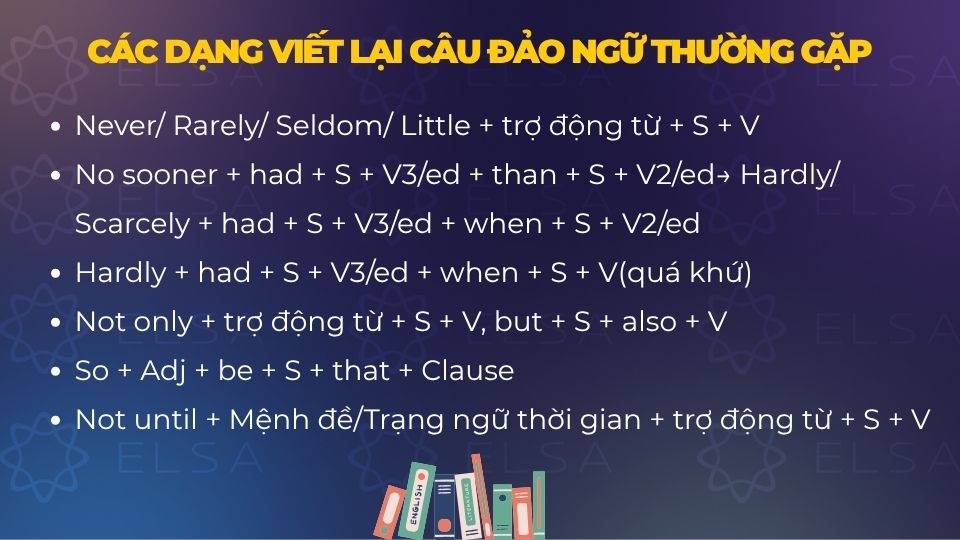
Viết lại câu đảo ngữ là dạng bài tập yêu cầu thay đổi trật tự thông thường của câu để nhấn mạnh một hành động/sự việc nào đó. Dạng bài này thường xuất hiện với các trạng từ phủ định như never, rarely, seldom, hardly, no sooner…
Dưới đây là bảng tổng hợp các dạng viết lại câu đảo ngữ thường gặp để bạn tham khảo:
| Cấu trúc | Ví dụ |
| Never/ Rarely/ Seldom/ Little + trợ động từ + S + V | She rarely speaks in public. (Cô ấy hiếm khi nói trước công chúng.)→ Rarely does she speak in public. (Hiếm khi nào cô ấy nói trước công chúng.) |
| No sooner + had + S + V3/ed + than + S + V2/ed→ Hardly/ Scarcely + had + S + V3/ed + when + S + V2/ed | No sooner had she entered the room than the phone rang. (Cô ấy vừa vào phòng thì điện thoại reo.)→ Hardly had she entered the room when the phone rang. (Vừa mới vào phòng thì điện thoại reo.) |
| Hardly + had + S + V3/ed + when + S + V(quá khứ) | Hardly had he left when the phone rang. (Ngay khi anh ấy đi thì điện thoại reo.) |
| Not only + trợ động từ + S + V, but + S + also + V | Not only is she talented in singing, but she is also skilled in playing the piano. (Cô ấy không chỉ tài năng ca hát mà còn chơi piano giỏi.) |
| So + Adj + be + S + that + Clause | So beautiful is the dress that everyone wants it. (Chiếc váy đẹp đến mức ai cũng muốn có.) |
| Not until + Mệnh đề/Trạng ngữ thời gian + trợ động từ + S + V | She did not go out until she finished her homework. (Cô ấy không đi chơi cho đến khi làm xong bài.) → Not until she finished her homework did she go out to play. (Mãi đến khi làm xong bài cô ấy mới đi chơi.) |
Viết lại câu điều kiện
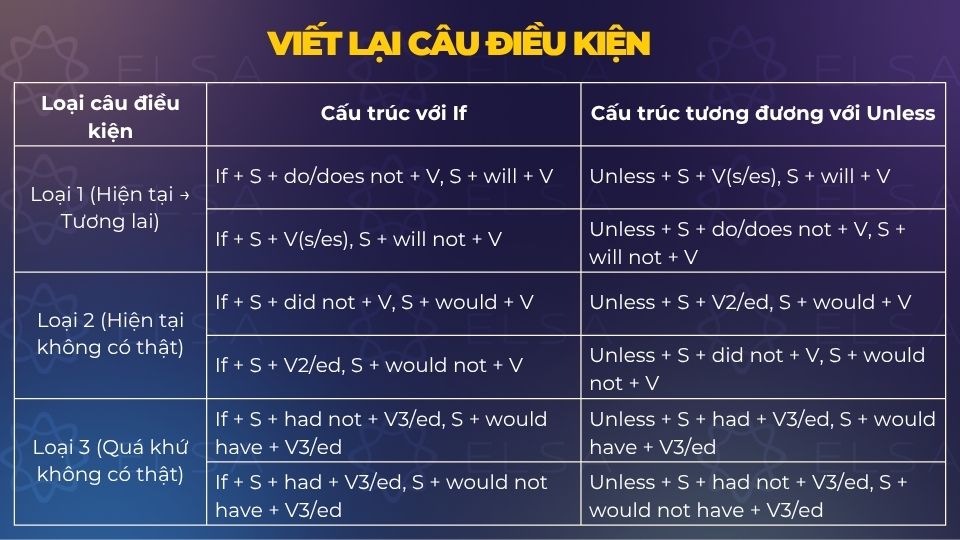
Dạng phổ biến nhất ở lớp 9 là chuyển đổi tương đương giữa If not và Unless, hoặc chuyển từ câu tình huống thực tế sang câu điều kiện giả định (câu điều kiện loại 2, câu điều kiện loại 3).
| Loại câu điều kiện | Cấu trúc với If | Cấu trúc tương đương với Unless |
| Loại 1 (Hiện tại → Tương lai) | If + S + do/does not + V, S + will + V | Unless + S + V(s/es), S + will + V |
| If + S + V(s/es), S + will not + V | Unless + S + do/does not + V, S + will not + V | |
| Loại 2 (Hiện tại không có thật) | If + S + did not + V, S + would + V | Unless + S + V2/ed, S + would + V |
| If + S + V2/ed, S + would not + V | Unless + S + did not + V, S + would not + V | |
| Loại 3 (Quá khứ không có thật) | If + S + had not + V3/ed, S + would have + V3/ed | Unless + S + had + V3/ed, S + would have + V3/ed |
| If + S + had + V3/ed, S + would not have + V3/ed | Unless + S + had not + V3/ed, S + would not have + V3/ed |
Ví dụ:
- If it doesn’t rain, we will go camping. → Unless it rains, we will go camping. (Trừ khi trời mưa, nếu không chúng tôi sẽ đi cắm trại.)
- If I didn’t have so much work, I would travel more. → Unless I had so much work, I would travel more. (Nếu tôi không có quá nhiều việc thì tôi sẽ đi du lịch nhiều hơn.)
- If they hadn’t left early, they would have missed the train. → Unless they had left early, they would have missed the train. (Nếu họ không rời đi sớm thì họ đã lỡ chuyến tàu.)
Các cấu trúc viết lại câu lớp 9 thường gặp khác
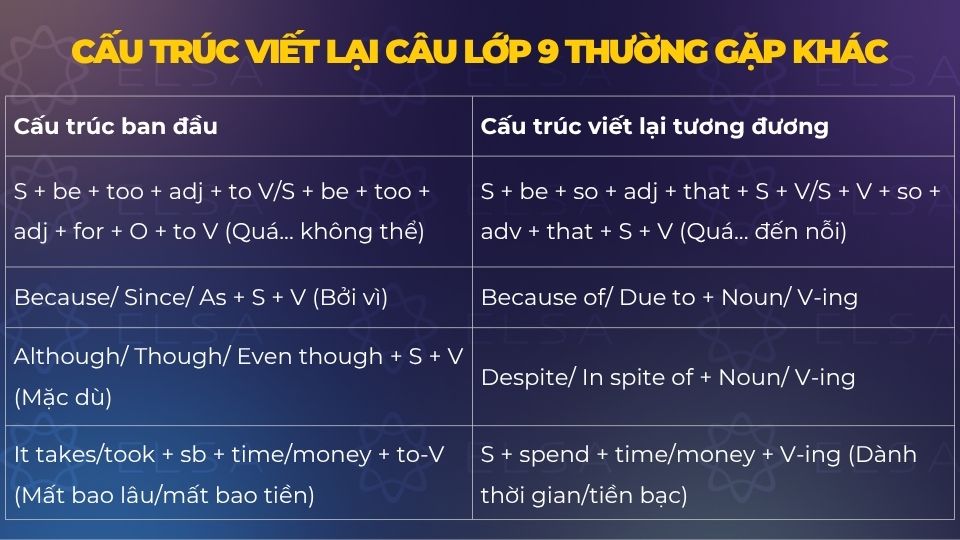
Bên cạnh các chủ điểm lớn trên, đề thi cũng rất hay kiểm tra các những mẫu câu cố định giúp diễn đạt cùng một ý theo nhiều cách khác nhau:
| Cấu trúc ban đầu | Cấu trúc viết lại tương đương | Ví dụ |
| S + be + too + adj + to V/S + be + too + adj + for + O + to V (Quá… không thể) | S + be + so + adj + that + S + V/S + V + so + adv + that + S + V (Quá… đến nỗi) | The coffee is too hot for me to drink. → The coffee is so hot that I cannot drink it. (Cà phê nóng đến mức tôi không thể uống.) |
| Because/Since/As + S + V (Bởi vì) | Because of/Due to + Noun/ V-ing | Because it rained heavily, we stayed home. → Because of the heavy rain, we stayed home. (Do trời mưa to, chúng tôi ở nhà.) |
| Although/Though/Even though + S + V (Mặc dù) | Despite/In spite of + Noun/ V-ing | Although he was tired, he finished the work. → Despite being tired, he finished the work. (Dù mệt, anh ấy vẫn làm xong việc.) |
| Let’s/Why don’t we… (Đề nghị) | Suggest + V-ing/Suggest + (that) + S + should + V | Let’s go to the cinema. → I suggest going to the cinema. (Tôi đề nghị đi xem phim.) |
| It takes/took + sb + time/money + to-V (Mất bao lâu/mất bao tiền) | S + spend + time/money + V-ing (Dành thời gian/tiền bạc) | It takes me two hours to do homework. → I spend two hours doing homework. (Tôi dành 2 tiếng để làm bài tập.) |
| There’s no point in + V-ing (Vô ích/Không đáng làm gì) | It’s no use/good + V-ing / It’s not worth + V-ing (Không đáng làm gì) | There’s no point in arguing with him. → It’s no use arguing with him. (Chẳng ích gì khi tranh cãi với anh ta.) |
| S + last + V2/ed + time + ago (Lần cuối làm gì) | The last time + S + V2/ed + was + time + ago | She last visited Paris a year ago. → The last time she visited Paris was a year ago. (Cô ấy đến Paris lần cuối 1 năm trước.) |
| S + began/started + to-V/V-ing + time + ago (Bắt đầu làm gì) | S + have/has + V3/ed + for/since + time | He started working here 3 years ago. → He has been working here for 3 years. (Anh ấy bắt đầu làm việc ở đây 3 năm trước.) |
| S + should/ought to/had better + V | It’s (high/about) time + S + V2/ed | You should finish your homework. → It’s time you finished your homework. (Bạn nên làm xong bài tập đi.) |
| S + like/enjoy/love + V-ing (thích) | S + be fond of/interested in/keen on + V-ing | He likes watching cartoons. → He is fond of watching cartoons. (Cậu ấy thích xem hoạt hình.) |
| S + would rather + V1 + than + V2 (thích làm gì hơn) | S + prefer + V-ing1 + to + V-ing2 | I would rather stay at home than go out. → I prefer staying at home to going out. (Tôi thích ở nhà hơn là ra ngoài.) |
Có thể bạn quan tâm: ELSA Speak hỗ trợ luyện phát âm tiếng Anh theo nhiều giọng tiếng Anh khác nhau (US – UK). Ứng dụng giúp người học làm quen với cách phát âm tiếng Anh chuẩn quốc tế và cải thiện khả năng nghe hiểu trong nhiều tình huống thực tế. Click tham khảo ngay!

Tổng hợp bài tập viết lại câu lớp 9 có đáp án
Bài tập viết lại câu với mệnh đề quan hệ lớp 9
- The book is interesting. I am reading it.
→ The book ____________________________________________________. - The teacher praised Sarah. Sarah had the highest score in the class.
→ The teacher praised Sarah, _______________________________________. - The man is a famous doctor. You met him yesterday.
→ The man ____________________________________________________. - I will never forget the day. We first met on that day.
→ I will never forget the day _______________________________________. - This is the house. I was born here.
→ This is the house ________________________________________________. - Do you know the boy? His father is a pilot.
→ Do you know the boy ____________________________________________? - The dynamic city attracts many tourists. It is located by the river.
→ The dynamic city ________________________________________________. - The students are very intelligent. They study in this classroom.
→ The students __________________________________________________. - I am looking for the keys. I left them on the table.
→ I am looking for the keys _________________________________________. - The woman was very kind. She helped me with my luggage.
→ The woman ___________________________________________________.
Đáp án
- The book which/that I am reading is interesting.
(Giải thích: “The book” là vật nên ta dùng đại từ quan hệ “which” hoặc “that” để thay thế cho tân ngữ “it” ở câu sau). - The teacher praised Sarah, who had the highest score in the class.
(Giải thích: “Sarah” là tên riêng, danh từ xác định nên dùng mệnh đề quan hệ không xác định với dấu phẩy, dùng “who” thay thế làm chủ ngữ chỉ người). - The man whom/that you met yesterday is a famous doctor. (Hoặc có thể dùng who hoặc lược bỏ đại từ quan hệ).
(Giải thích: “The man” là người, đóng vai trò tân ngữ ở câu sau nên thay bằng “whom/that”). - I will never forget the day when we first met. (Hoặc on which).
(Giải thích: “the day” là danh từ chỉ thời gian nên ta dùng trạng từ quan hệ “when”). - This is the house where I was born. (Hoặc in which).
(Giải thích: “the house” kết hợp với từ “here” chỉ nơi chốn nên ta dùng trạng từ quan hệ “where”). - Do you know the boy whose father is a pilot?
(Giải thích: “His father” chỉ sự sở hữu của cậu bé nên ta thay bằng “whose + Noun”). - The dynamic city which/that is located by the river attracts many tourists.
(Giải thích: “The dynamic city” là vật, đóng vai trò chủ ngữ ở câu sau nên thay bằng “which/that”). - The students who study in this classroom are very intelligent.
(Giải thích: “The students” là người, làm chủ ngữ ở câu sau nên dùng “who”). - I am looking for the keys which/that I left on the table.
(Giải thích: Lược bỏ tân ngữ “them” và thay bằng đại từ quan hệ chỉ vật “which/that”). - The woman who helped me with my luggage was very kind.
(Giải thích: “The woman” là người, làm chủ ngữ ở câu sau nên dùng “who”).
Bài tập viết lại câu ước lớp 9
- I don’t have enough money to buy that laptop.
→ I wish ______________________________________________________. - She can’t speak English fluently.
→ She wishes ___________________________________________________. - It is raining heavily outside, so we can’t go out.
→ We wish _____________________________________________________. - I am sorry I didn’t invite him to the party yesterday.
→ I wish ______________________________________________________. - He always makes a lot of noise at night, which annoys me.
→ I wish he ____________________________________________________. - My sister has to work on Sunday.
→ My sister wishes ________________________________________________. - I don’t know the answer to this question.
→ I wish ______________________________________________________. - They live too far from the city center.
→ They wish ____________________________________________________. - What a pity that you can’t come with us.
→ I wish ______________________________________________________. - He failed the exam because he didn’t study hard.
→ He wishes ____________________________________________________.
Đáp án
- I wish I had enough money to buy that laptop.
(Giải thích: Câu ước ở hiện tại trái với thực tế hiện tại → lùi về thì Quá khứ đơn: don’t have → had). - She wishes she could speak English fluently.
(Giải thích: Câu ước năng lực hiện tại → chuyển can’t → could). - We wish it weren’t raining heavily outside so we could go out. (Hoặc We wish it stopped raining…)
(Giải thích: Ước trái với hiện tại tiếp diễn → chuyển sang Quá khứ tiếp diễn: is raining → weren’t raining). - I wish I had invited him to the party yesterday.
(Giải thích: Câu ước trái với quá khứ (yesterday) → lùi về thì Quá khứ hoàn thành: didn’t invite → had invited). - I wish he wouldn’t make a lot of noise at night.
(Giải thích: Câu ước thể hiện sự phàn nàn về một thói quen xấu của người khác → dùng cấu trúc S + wish + S + wouldn’t + V). - My sister wishes she didn’t have to work on Sunday.
(Giải thích: Trái với hiện tại “has to” → chuyển thành “didn’t have to”). - I wish I knew the answer to this question.
(Giải thích: Trái với hiện tại “don’t know” → chuyển thành “knew”). - They wish they didn’t live too far from the city center. (Hoặc …lived closer to the city center).
(Giải thích: Ước trái với thực tế hiện tại). - I wish you could come with us.
(Giải thích: Cụm “What a pity that…” thể hiện sự nuối tiếc, ước điều không thể ở hiện tại dùng “could + V”). - He wishes he had studied hard.
(Giải thích: Sự nuối tiếc trong quá khứ → dùng Quá khứ hoàn thành).
Bài tập viết lại câu với phrasal verb lớp 9
- You should try to extinguish the fire before leaving. (PUT)
→ You should ___________________________________________________. - She decided to reject the job offer. (TURN)
→ She decided __________________________________________________. - The match was postponed because of the rain. (PUT)
→ The match was _________________________________________________. - I accidentally met an old friend at the supermarket. (RUN)
→ I accidentally __________________________________________________. - He is investigating the cause of the accident. (LOOK)
→ He is _______________________________________________________. - Make sure you find the meaning of this word in the dictionary. (LOOK)
→ Make sure you _________________________________________________. - My alarm clock rang at 6 AM. (GO)
→ My alarm clock _________________________________________________. - She has a good relationship with her colleagues. (GET)
→ She ________________________________________________________. - You must complete this application form. (FILL)
→ You must ____________________________________________________. - He recovered from his illness very quickly. (GET)
→ He ________________________________________________________.
Đáp án
- You should try to put out the fire before leaving.
(Giải thích: Cụm phrasal verb “put out” có nghĩa là dập tắt = extinguish). - She decided to turn down the job offer.
(Giải thích: “turn down” có nghĩa là từ chối = reject). - The match was put off because of the rain.
(Giải thích: “put off” có nghĩa là trì hoãn = postpone. Chú ý giữ đúng dạng bị động). - I accidentally ran into an old friend at the supermarket.
(Giải thích: “run into” có nghĩa là tình cờ gặp ai đó = accidentally meet. Câu gốc ở quá khứ đơn nên dùng “ran”). - He is looking into the cause of the accident.
(Giải thích: “look into” có nghĩa là điều tra, làm rõ = investigate. Giữ nguyên thì Hiện tại tiếp diễn). - Make sure you look up this word in the dictionary.
(Giải thích: “look up” có nghĩa là tra cứu thông tin trong từ điển/sách). - My alarm clock went off at 6 AM.
(Giải thích: “go off” đối với đồng hồ nghĩa là reo chuông. Quá khứ của go là went). - She gets on well with her colleagues. (Hoặc gets along well with).
(Giải thích: Cụm “get on well with someone” nghĩa là hòa đồng, có mối quan hệ tốt với ai). - You must fill in/out this application form.
(Giải thích: “fill in” hoặc “fill out” mang nghĩa là điền thông tin vào mẫu đơn). - He got over his illness very quickly.
(Giải thích: “get over” mang nghĩa là vượt qua, bình phục sau trận ốm = recover từ quá khứ “recovered” → “got over”).
Bài tập trắc nghiệm viết lại câu lớp 9
- “Why don’t we go to the cinema tonight?” Mark said.
A. Mark denied going to the cinema tonight.
B. Mark suggested going to the cinema that night.
C. Mark refused to go to the cinema that night.
D. Mark promised to go to the cinema that night. - Although he was exhausted, he completed the marathon.
A. Despite his exhaustion, he completed the marathon.
B. In spite of he was exhausted, he completed the marathon.
C. He completed the marathon because he was exhausted.
D. Exhausted as he is, he completed the marathon. - No other river in the world is longer than the Nile.
A. The Nile is as long as other rivers in the world.
B. The Nile is the longest river in the world.
C. Other rivers in the world are longer than the Nile.
D. The Nile is longer than the longest river in the world. - They have built a new bridge over the river recently.
A. A new bridge over the river has been built recently.
B. A new bridge over the river was built recently.
C. A new bridge has recently built over the river.
D. A new bridge has been building over the river recently. - If it doesn’t rain tomorrow, we will go camping.
A. Unless it rains tomorrow, we won’t go camping.
B. Unless it doesn’t rain tomorrow, we will go camping.
C. Unless it rains tomorrow, we will go camping.
D. Provided that it rains tomorrow, we will go camping. - It took her two hours to decorate her living room.
A. She spent two hours to decorate her living room.
B. She spent two hours decorating her living room.
C. She was spent two hours decorating her living room.
D. It was spent two hours by her decorating her living room. - I haven’t seen my childhood friend for five years.
A. The last time I saw my childhood friend was five years ago.
B. I last saw my childhood friend since five years.
C. It is five years since I haven’t seen my childhood friend.
D. I started seeing my childhood friend five years ago. - The book was so interesting that I read it all night.
A. So interesting was the book that I read it all night.
B. The book was too interesting for me to read it all night.
C. It was an interesting book enough for me to read all night.
D. It was such an interesting book that I read it all night. - “Don’t touch this switch, Tim,” said his father.
A. Tim’s father advised him not to touch that switch.
B. Tim’s father warned him against not touching that switch.
C. Tim’s father told him not to touch that switch.
D. Tim’s father suggested him not to touch that switch. - The coffee was too hot for me to drink.
A. The coffee was so hot that I couldn’t drink it.
B. The coffee wasn’t hot enough for me to drink.
C. It was such hot coffee that I could drink it.
D. The coffee was hot enough for me to drink. - He didn’t pass the exam because he didn’t study hard.
A. If he studied hard, he would pass the exam.
B. If he had studied hard, he would have passed the exam.
C. If he studies hard, he will pass the exam.
D. He would pass the exam if he studies hard. - This is the first time I have ever tasted such a delicious dish.
A. I have ever tasted a more delicious dish than this one.
B. I have never tasted such a delicious dish before.
C. I tasted this delicious dish for the first time ago.
D. This dish is the most delicious I tasted before. - People say that the ancient temple was built in the 12th century.
A. The ancient temple is said to have been built in the 12th century.
B. It is said that the ancient temple to be built in the 12th century.
C. The ancient temple is said to be built in the 12th century.
D. People are said that the ancient temple was built in the 12th century. - He started working as an accountant three years ago.
A. He has worked as an accountant since three years.
B. He worked as an accountant for three years.
C. He has worked as an accountant for three years.
D. It is three years since he has worked as an accountant. - He is not old enough to drive a car.
A. He is too young to drive a car.
B. He is so young that he can drive a car.
C. He is such a young boy to drive a car.
D. He isn’t enough old to drive a car.
Đáp án:
| 1 | 2 | 3 | 4 | 5 |
| B | A | B | A | C |
| 6 | 7 | 8 | 9 | 10 |
| B | A | D | C | A |
| 11 | 12 | 13 | 14 | 15 |
| B | B | A | C | A |
Bài tập viết lại câu bị động lớp 9
- The company developed a new software program.
→ A new software program _________________________________________. - The construction team is building a new bridge across the river.
→ A new bridge is _________________________________________________. - They will complete the project by the end of this month.
→ The project ____________________________________________________. - People say that he is a multi-millionaire.
→ He is ________________________________________________________. - My mother punishes my brother whenever he is lazy.
→ My brother ____________________________________________________. - No one has used this room for years.
→ This room ____________________________________________________. - You must clean your room before going out.
→ Your room ____________________________________________________. - They are repairing my car at the garage now.
→ My car _______________________________________________________. - Did the fire destroy the whole forest?
→ Was the whole forest ____________________________________________? - She gave me a beautiful dress on my birthday.
→ I was ________________________________________________________.
Đáp án
- A new software program was developed by the company.
(Giải thích: Câu gốc ở thì Quá khứ đơn → cấu trúc bị động: was/were + V3). - A new bridge is being built across the river by the construction team.
(Giải thích: Câu gốc ở Hiện tại tiếp diễn → cấu trúc bị động: am/is/are + being + V3). - The project will be completed by the end of this month.
(Giải thích: Câu gốc ở Tương lai đơn → cấu trúc bị động: will be + V3). - He is said to be a multi-millionaire. (Hoặc It is said that he is a multi-millionaire).
(Giải thích: Cấu trúc bị động đặc biệt với các động từ chỉ quan điểm, ý kiến như say, believe, report…). - My brother is punished by my mother whenever he is lazy.
(Giải thích: Câu gốc ở Hiện tại đơn → bị động: am/is/are + V3). - This room has not been used for years.
(Giải thích: Chủ ngữ câu gốc là phủ định “No one” nên khi chuyển sang bị động của Hiện tại hoàn thành phải thêm “not” → has not been + V3, bỏ “by no one”). - Your room must be cleaned before you go out.
(Giải thích: Bị động với động từ khiếm khuyết: must be + V3). - My car is being repaired at the garage now.
(Giải thích: Hiện tại tiếp diễn số ít đi với “is being repaired”). - Was the whole forest destroyed by the fire?
(Giải thích: Thể bị động của câu hỏi ở thì Quá khứ đơn: Was/Were + S + V3?). - I was given a beautiful dress on my birthday by her.
(Giải thích: Câu gốc có hai tân ngữ “me” (gián tiếp) và “a beautiful dress” (trực tiếp). Đề bài bắt đầu bằng “I” nên ta dùng tân ngữ gián tiếp làm chủ ngữ mới).
Bài tập viết lại câu tường thuật lớp 9
- She said, “She will meet us at the coffee shop for a quick chat.”
→ She said that __________________________________________________. - Mary told, “This is the best gift I’ve ever received.”
→ Mary said that _________________________________________________. - “Are you coming to the party tonight?” Peter asked me.
→ Peter asked me _________________________________________________. - “What time does the meeting start?” the manager asked.
→ The manager asked _____________________________________________. - “Don’t touch this button,” the engineer told us.
→ The engineer told us _____________________________________________. - “Please help me with this heavy box,” the old woman said to him.
→ The old woman asked him _________________________________________. - “Where did you buy this beautiful bag?” Linda asked her sister.
→ Linda asked her sister ____________________________________________. - “I am going to the market now,” my mom said.
→ My mom said that ________________________________________________. - “What a beautiful dress!” she exclaimed.
→ She exclaimed that _______________________________________________. - “If I were you, I would study harder,” my teacher said to me.
→ My teacher advised ______________________________________________.
Đáp án
- She said that she would meet them at the coffee shop for a quick chat.
(Giải thích: Lùi thì will → would; đổi tân ngữ us → them). - Mary said that that was the best gift she had ever received.
(Giải thích: Đổi đại từ I → she; lùi thì is → was; have received → had received; từ “this” đứng một mình thành “that”). - Peter asked me if/whether I was coming to the party that night.
(Giải thích: Câu hỏi Yes/No thêm if/whether, đưa chủ ngữ lên trước động từ và lùi thì: are you coming → I was coming, đổi tonight → that night). - The manager asked what time the meeting started.
(Giải thích: Câu hỏi Wh-word, bỏ trợ động từ “does” và lùi động từ chính “start” → “started”). - The engineer told us not to touch that button.
(Giải thích: Cấu trúc mệnh lệnh phủ định: S + told + O + not to-V, đổi this → that). - The old woman asked him to help her with that heavy box.
(Giải thích: Cấu trúc câu yêu cầu lịch sự “Please…” chuyển thành ask + O + to-V). - Linda asked her sister where she had bought that beautiful bag.
(Giải thích: Câu hỏi ở thì Quá khứ đơn lùi về Quá khứ hoàn thành: did you buy → she had bought, đổi this → that). - My mom said that she was going to the market then.
(Giải thích: Lùi thì Hiện tại tiếp diễn thành Quá khứ tiếp diễn, đổi trạng từ now → then). - She exclaimed that the dress was beautiful.
(Giải thích: Câu tường thuật dạng cảm thán với “exclaim that + S + V(lùi thì)”). - My teacher advised me to study harder.
(Giải thích: Câu điều kiện loại 2 mang ý nghĩa lời khuyên “If I were you…” được viết lại bằng cấu trúc khuyên bảo: S + advise + O + to-V).
Bài tập viết lại câu điều kiện lớp 9
- I don’t know her phone number, so I can’t call her.
→ If I ______________________________________________________. - Eat less junk food or you will gain weight.
→ If you ______________________________________________________. - She doesn’t have a map, so she gets lost.
→ If she ______________________________________________________. - Hurry up, otherwise we will miss the last bus.
→ Unless you ___________________________________________________. - Because I am busy, I cannot go to the cinema with you.
→ If I ______________________________________________________. - He is lazy, that’s why he always gets bad marks.
→ If he ______________________________________________________. - Because it is raining, we can’t play football.
→ If it ______________________________________________________. - You don’t practice regular exercise, so you aren’t fit.
→ Unless you ___________________________________________________. - She is too young, so she isn’t allowed to drive a car.
→ If she ______________________________________________________. - Stay hydrated or you will feel exhausted.
→ If you don’t __________________________________________________.
Đáp án
- If I knew her phone number, I could call her.
(Giải thích: Sự thật hiện tại là không biết → giả định trái với thực tế dùng Câu điều kiện loại 2). - If you don’t eat less junk food, you will gain weight. (Hoặc If you eat a lot of junk food…).
(Giải thích: Câu cảnh báo điều có thể xảy ra ở tương lai → dùng Câu điều kiện loại 1). - If she had a map, she wouldn’t get lost.
(Giải thích: Điều kiện loại 2, vế khẳng định biến thành phủ định và ngược lại). - Unless you hurry up, we will miss the last bus.
(Giải thích: Cấu trúc “Unless = If… not”. Unless đứng trước một mệnh đề khẳng định). - If I weren’t busy, I could go to the cinema with you.
(Giải thích: Trái với hiện tại đang bận, dùng điều kiện loại 2, động từ to be luôn dùng “were/weren’t” cho tất cả các ngôi). - If he weren’t lazy, he wouldn’t always get bad marks.
(Giải thích: Điều kiện loại 2 phủ định lại tính từ “lazy”). - If it weren’t raining, we could play football.
(Giải thích: Đưa hành động “is raining” hiện tại về giả định quá khứ “weren’t raining”). - Unless you practice regular exercise, you won’t be fit.
(Giải thích: Loại bỏ “don’t” sau Unless). - If she weren’t so young, she would be allowed to drive a car.
(Giải thích: Điều kiện loại 2 giả định tuổi lớn hơn). - If you don’t stay hydrated, you will feel exhausted.
(Giải thích: Câu điều kiện loại 1 dạng phủ định vế đầu).
Bài tập viết lại câu so sánh lớp 9
- This movie is not as exciting as that one.
→ That movie is _________________________________________________. - Gold is heavier than silver.
→ Silver is _____________________________________________________. - No one in my class is taller than John.
→ John is ______________________________________________________. - She is the most intelligent girl I’ve ever met.
→ I have never ___________________________________________________. - This hotel is cheaper than any other hotel in the city.
→ This hotel is ___________________________________________________. - As the test gets closer, the students get more nervous.
→ The closer ____________________________________________________. - Cooking at home is healthier than eating out.
→ Eating out is __________________________________________________. - I don’t run as fast as he does.
→ He runs _____________________________________________________. - The weather becomes hotter, and I feel more uncomfortable.
→ The hotter ____________________________________________________. - This is the best meal I’ve ever had.
→ I’ve never ____________________________________________________.
Đáp án
- That movie is more exciting than this one.
(Giải thích: So sánh không bằng “not as… as” chuyển ngược thành so sánh hơn “more… than”). - Silver is lighter than gold. (Hoặc Silver is not as heavy as gold).
(Giải thích: Đổi chủ ngữ và tìm tính từ trái nghĩa với heavy là light). - John is the tallest student in my class.
(Giải thích: Không ai bằng → Người đó là nhất. Dùng so sánh nhất tính từ ngắn: the tallest). - I have never met a more intelligent girl than her.
(Giải thích: Viết lại từ so sánh nhất sang cấu trúc “I have never + V3 + a/an + so sánh hơn + N + than…”). - This hotel is the cheapest hotel in the city.
(Giải thích: Rẻ hơn bất kỳ khách sạn nào khác → Rẻ nhất). - The closer the test gets, the more nervous the students get.
(Giải thích: So sánh đồng tiến Càng… càng… Đưa từ so sánh hơn lên trước danh từ chủ ngữ). - Eating out is less healthy than cooking at home. (Hoặc is not as healthy as).
(Giải thích: Chuyển sang dùng so sánh kém “less + tính từ dài + than”). - He runs faster than I do / me.
(Giải thích: Chuyển trạng từ fast dạng không bằng sang dạng so sánh hơn). - The hotter the weather becomes, the more uncomfortable I feel.
(Giải thích: So sánh đồng tiến phối hợp tính từ ngắn “hot” và tính từ dài “uncomfortable”). - I’ve never had a better meal than this one.
(Giải thích: Chuyển từ tốt nhất (best) sang tốt hơn (better) kết hợp với từ phủ định).
Bài tập viết lại câu used to lớp 9
- He often went fishing when he was a child, but he doesn’t anymore.
→ He used _____________________________________________________. - There was a big tree in front of my house, but it was cut down.
→ There used ____________________________________________________. - She didn’t like vegetables before, but now she loves them.
→ She didn’t use _________________________________________________. - I am getting familiar with driving on the left in London.
→ I am getting used _______________________________________________. - Walking to school every morning is no longer a problem for her.
→ She is used ____________________________________________________. - My father smoked a lot in the past, but he gave it up.
→ My father used _________________________________________________. - Did you often play marbles when you were young?
→ Did you use ___________________________________________________? - He now finds it normal to stay up late working.
→ He is used ____________________________________________________. - We don’t hang out together anymore.
→ We used _____________________________________________________. - It takes time for me to accept the new regulations.
→ I am getting used _______________________________________________.
Đáp án
- He used to go fishing when he was a child.
(Giải thích: Diễn tả thói quen trong quá khứ đã chấm dứt: S + used to + V-bare). - There used to be a big tree in front of my house.
(Giải thích: Diễn tả một trạng thái từng tồn tại trong quá khứ). - She didn’t use to like vegetables.
(Giải thích: Cấu trúc phủ định của used to: S + didn’t use to + V). - I am getting used to driving on the left in London.
(Giải thích: Quá trình trở nên quen với việc gì: S + get used to + V-ing). - She is used to walking to school every morning.
(Giải thích: Đã quen với việc gì ở hiện tại: S + be used to + V-ing). - My father used to smoke a lot in the past.
(Giải thích: Thói quen từng có trong quá khứ). - Did you use to play marbles when you were young?
(Giải thích: Cấu trúc câu hỏi: Did + S + use to + V?). - He is used to staying up late working.
(Giải thích: Cụm “find it normal to V” dịch ra là quen với việc gì → dùng be used to + V-ing). - We used to hang out together.
(Giải thích: Từng làm gì cùng nhau trong quá khứ). - I am getting used to accepting the new regulations.
(Giải thích: “It takes time to…” chỉ sự thích nghi dần dần → dùng get used to + V-ing).
Bài tập viết lại câu với cấu trúc đảo ngữ
- He rarely misses his morning jog.
→ Rarely ______________________________________________________. - She never forgets to call her parents every Sunday.
→ Never ______________________________________________________. - She did not go out to play until she finished her homework.
→ Not until ____________________________________________________. - He had hardly turned on the TV when the electricity went out.
→ Hardly ______________________________________________________. - As soon as the teacher entered the classroom, the students stood up.
→ No sooner ____________________________________________________. - They not only lost their money but also their passports.
→ Not only _____________________________________________________. - I little realized that she was a famous actress.
→ Little _______________________________________________________. - He didn’t know the truth until he read the letter.
→ Not until ____________________________________________________. - She seldom goes to the theater.
→ Seldom _____________________________________________________. - The rain didn’t stop until midnight.
→ Not until ____________________________________________________.
Đáp án
- Rarely does he miss his morning jog.
(Giải thích: Đảo ngữ với trạng từ tần suất phủ định, mượn trợ động từ “does” của thì Hiện tại đơn). - Never does she forget to call her parents every Sunday.
(Giải thích: Đảo từ phủ định Never lên đầu câu và đảo ngữ vế sau). - Not until she finished her homework did she go out to play.
(Giải thích: Cấu trúc: Not until + mệnh đề thời gian + đảo ngữ vế sau (mượn trợ động từ did)). - Hardly had he turned on the TV when the electricity went out.
(Giải thích: Đảo ngữ cấu trúc Vừa mới… thì… với thì Quá khứ hoàn thành). - No sooner had the teacher entered the classroom than the students stood up.
(Giải thích: Đảo cấu trúc “No sooner had + S + V3 + than + S + V2”). - Not only did they lose their money, but they also lost their passports.
(Giải thích: Đảo ngữ vế đầu tiên chứa “not only” lên trước chủ ngữ). - Little did I realize that she was a famous actress.
(Giải thích: Đảo từ “Little” lên đầu câu làm phủ định nhấn mạnh, mượn trợ động từ “did”). - Not until he read the letter did he know the truth.
(Giải thích: Toàn bộ mệnh đề thời gian “he read the letter” đi liền sau Not until, vế sau đảo ngữ). - Seldom does she go to the theater.
(Giải thích: Đảo ngữ Hiện tại đơn với từ Seldom). - Not until midnight did the rain stop.
(Giải thích: Sau Not until có thể đi kèm một mốc thời gian danh từ như “midnight”, vế sau đảo ngữ).
Bài tập viết lại câu với because/because of
- Since she missed the train, she arrived late to the meeting.
→ Because of ___________________________________________________. - Because the weather is bad, they postponed the outdoor event.
→ Because of ___________________________________________________. - He couldn’t go to school because he was seriously ill.
→ Because of ___________________________________________________. - Because the traffic was heavy, we didn’t arrive on time.
→ Due to ______________________________________________________. - As she worked hard, she passed the exam easily.
→ As a result of __________________________________________________. - The flight was delayed because it was foggy.
→ Because of ___________________________________________________. - Because he has a prior commitment, he couldn’t attend the meeting.
→ Because of ___________________________________________________. - They canceled the picnic because it rained heavily.
→ Due to ______________________________________________________. - She couldn’t sleep well because she was worried.
→ Because of ___________________________________________________. - Since the book was expensive, I didn’t buy it.
→ Because of ___________________________________________________.
Đáp án
- Because of missing the train, she arrived late to the meeting.
(Giải thích: Do hai vế cùng chủ ngữ “she”, ta rút gọn mệnh đề sau because thành V-ing). - Because of the bad weather, they postponed the outdoor event.
(Giải thích: Chuyển mệnh đề “the weather is bad” thành cụm danh từ “the bad weather”). - Because of his serious illness, he couldn’t go to school.
(Giải thích: Biến đổi cụm “he was seriously ill” thành cụm danh từ bằng cách dùng tính từ sở hữu “his” + tính từ “serious” + danh từ “illness”). - Due to the heavy traffic, we didn’t arrive on time.
(Giải thích: Chuyển mệnh đề thành cụm danh từ đứng sau Due to). - As a result of her hard work, she passed the exam easily.
(Giải thích: Biến “she worked hard” thành cụm danh từ “her hard work”). - Because of the fog, the flight was delayed.
(Giải thích: Chuyển tính từ “foggy” thành danh từ “the fog”). - Because of a prior commitment, he couldn’t attend the meeting.
(Giải thích: Sau because đã có sẵn danh từ “a prior commitment” đi với động từ has, ta lược bỏ động từ chủ ngữ chỉ lấy cụm danh từ). - Due to the heavy rain, they canceled the picnic.
(Giải thích: Biến đổi trạng từ + động từ “rained heavily” thành tính từ + danh từ “heavy rain”). - Because of her worry, she couldn’t sleep well. (Hoặc Because of being worried).
(Giải thích: Chuyển sang danh từ hoặc dạng V-ing). - Because of the high price of the book, I didn’t buy it. (Hoặc Because of the expensive book).
(Giải thích: Biến đổi tính chất đắt đỏ thành cụm danh từ).
Bài tập viết lại câu với although/despite
- Although her family expected her to choose a more traditional career path, she decided to pursue her passion for art.
→ Despite _____________________________________________________. - Even though the concert tickets were expensive, they were determined to attend the performance.
→ Despite _____________________________________________________. - Although it was raining, they decided to go for a hike.
→ Despite _____________________________________________________. - In spite of being tired, he stayed up late to finish his project.
→ Although ____________________________________________________. - Despite her poor health, she managed to win the competition.
→ Even though __________________________________________________. - Although he had a lot of experience, he didn’t get the job.
→ In spite of ____________________________________________________. - Even though she made a lot of mistakes, she wasn’t punished.
→ Despite _____________________________________________________. - In spite of the heavy snow, the trains ran on time.
→ Though _____________________________________________________. - Although he lived far from the office, he was never late for work.
→ Despite _____________________________________________________. - She passed the driving test, although she was very nervous.
→ In spite of ____________________________________________________.
Đáp án
- Despite her family’s expectation for her to choose a more traditional career path, she decided to pursue her passion for art.
(Giải thích: Biến đổi mệnh đề “her family expected her…” thành cụm danh từ sở hữu). - Despite the expensive concert tickets, they were determined to attend the performance.
(Giải thích: Chuyển cấu trúc mệnh đề tính từ “tickets were expensive” thành cụm danh từ “expensive tickets”). - Despite the rain, they decided to go for a hike. (Hoặc Despite it raining).
(Giải thích: Chuyển cấu trúc thời tiết “it was raining” thành cụm danh từ ngắn “the rain”). - Although he was tired, he stayed up late to finish his project.
(Giải thích: Viết từ cụm V-ing sang mệnh đề hoàn chỉnh đầy đủ S + V). - Even though her health was poor, she managed to win the competition.
(Giải thích: Chuyển cụm danh từ “her poor health” thành một mệnh đề). - In spite of having a lot of experience, he didn’t get the job.
(Giải thích: Hai vế cùng chủ ngữ “he” nên ta dùng luôn V-ing “having”). - Despite making a lot of mistakes, she wasn’t punished.
(Giải thích: Đồng chủ ngữ rút gọn mệnh đề sau Even though thành dạng V-ing). - Though it snowed heavily, the trains ran on time.
(Giải thích: Khai triển cụm danh từ “the heavy snow” thành mệnh đề hoàn chỉnh). - Despite living far from the office, he was never late for work.
(Giải thích: Rút gọn đồng chủ ngữ thành V-ing đứng sau Despite). - She passed the driving test in spite of her nervousness / being nervous.
(Giải thích: Chuyển tính từ “nervous” thành danh từ “nervousness”).
Bài tập viết lại câu với so/ such
- The weather is so hot that we decided to stay indoors.
→ It is ________________________________________________________. - The movie is so interesting that I couldn’t stop watching it.
→ It is such _____________________________________________________. - The box is so heavy that he cannot lift it.
→ It is such _____________________________________________________. - It was such a beautiful day that we went on a picnic.
→ The day was so _________________________________________________. - The dress was so expensive that she didn’t buy it.
→ It was such ____________________________________________________. - He is such a polite boy that everyone loves him.
→ The boy is so _________________________________________________. - The music is so loud that he can’t concentrate.
→ It is such _____________________________________________________. - The test was so difficult that no student could finish it.
→ It was such _____________________________________________________. - It is such an amazing book that I have read it three times.
→ The book is so _________________________________________________. - The tea is so hot that I can’t drink it right now.
→ It is such _____________________________________________________.
Đáp án
- It is such hot weather that we decided to stay indoors.
(Giải thích: “weather” là danh từ không đếm được nên ta không dùng “a/an” sau such). - It is such an interesting movie that I couldn’t stop watching it.
(Giải thích: Cấu trúc “such + a/an + Adj + N + that”. “interesting” bắt đầu bằng một nguyên âm nên dùng “an”). - It is such a heavy box that he cannot lift it.
(Giải thích: Áp dụng công thức Such + a + tính từ + danh từ đếm được số ít). - The day was so beautiful that we went on a picnic.
(Giải thích: Chuyển từ cấu trúc Such sang cấu trúc So: S + be + so + Adj + that). - It was such an expensive dress that she didn’t buy it.
(Giải thích: Chuyển sang cấu trúc với such, dùng “an” trước từ “expensive”). - The boy is so polite that everyone loves him.
(Giải thích: Đưa danh từ “the boy” lên đầu làm chủ ngữ câu mới phối hợp với cấu trúc so… that). - It is such loud music that he can’t concentrate.
(Giải thích: “music” là danh từ không đếm được nên cấu trúc không có “a/an”). - It was such a difficult test that no student could finish it.
(Giải thích: Thêm danh từ “test” vào cụm của such). - The book is so amazing that I have read it three times.
(Giải thích: Chuyển ngược lại sang cấu trúc So + tính từ). - It is such hot tea that I can’t drink it right now.
(Giải thích: “tea” không đếm được nên dùng “such + Adj + N”).
Bài tập viết lại câu lớp 9 nâng cao
- She spends two hours studying every day.
→ It ________________________________________________________. - There’s no point in trying to fix the old computer.
→ It’s no _____________________________________________________. - She didn’t realize her mistake until she received the feedback.
→ It was not ___________________________________________________. - He ought to apologize for his behavior.
→ It’s about time _________________________________________________. - What a beautiful sunset!
→ How ________________________________________________________! - She last visited her hometown three years ago.
→ The last time __________________________________________________. - She started learning Spanish three months ago.
→ She has ______________________________________________________. - How about going to the movies?
→ Why don’t ____________________________________________________? - They visited the amusement park three months ago.
→ The last time _______________ - The company started to expand its operations two years ago.
→ The company has _______________________________________________. - They spend a lot of time traveling to different countries.
→ It takes ______________________________________________________. - It’s no use studying without proper materials.
→ It’s not worth __________________________________________________. - He didn’t understand the importance of time management until he missed a crucial deadline.
→ It was not until ________________________________________________. - The book is on the shelf. I borrowed it from the library. (Relative Clause)
→ The book that __________________________________________________. - If she doesn’t try harder, she will fail the exam.
→ Unless _______________________________________________________. - “Why don’t you take a break, Tom?” said the doctor.
→ The doctor suggested _____________________________________________. - I would rather stay at home than go to the party.
→ I prefer ______________________________________________________. - People believe that the pyramids were built by aliens.
→ The pyramids ___________________________________________________. - He was so weak that he couldn’t stand up.
→ He was too ____________________________________________________. - As soon as he arrived at the airport, he realized he forgot his passport.
→ No sooner ____________________________________________________.
Đáp án
- It takes her two hours to study every day.
(Giải thích: Chuyển đổi giữa cấu trúc spend time làm gì sang cấu trúc It takes sb time to-V). - It’s no use/good trying to fix the old computer.
(Giải thích: “There is no point in + V-ing” đồng nghĩa với “It is no use/good + V-ing” – không đáng/vô ích khi làm gì). - It was not until she received the feedback that she realized her mistake.
(Giải thích: Cấu trúc nhấn mạnh “It was not until + mốc thời gian/mệnh đề thời gian + THAT + mệnh đề chính (chia khẳng định ở quá khứ)”). - It’s about time he apologized for his behavior.
(Giải thích: Cấu trúc “It’s about/high time + S + V2/ed” – Đã đến lúc ai đó phải làm gì). - How beautiful the sunset is!
(Giải thích: Chuyển đổi câu cảm thán từ dạng “What + a/an + Adj + N!” sang “How + Adj + S + be!”). - The last time she visited her hometown was three years ago.
(Giải thích: Cấu trúc diễn tả lần cuối cùng làm gì). - She has been learning Spanish for three months. (Hoặc She has learned…).
(Giải thích: Chuyển từ thì Quá khứ đơn (started + V-ing + thời gian + ago) sang thì Hiện tại hoàn thành/Hiện tại hoàn thành tiếp diễn đi kèm giới từ “for”). - Why don’t we go to the movies?
(Giải thích: Đồng nghĩa của lời gợi ý). - The last time they visited the amusement park was three months ago.
(Giải thích: chú ý động từ to be ở quá khứ là “was”). - The company has been expanding its operations for two years. (Hoặc has expanded).
(Giải thích: Đưa từ quá khứ đơn sang hiện tại hoàn thành tiếp diễn nhằm nhấn mạnh hành động liên tục). - It takes them a lot of time to travel to different countries.
(Giải thích: Áp dụng chuẩn công thức It takes + O + time + to-V). - It’s not worth studying without proper materials.
(Giải thích: Cấu trúc tương đương “It’s no use + V-ing” = “It’s not worth + V-ing” – Không đáng để làm gì). - It was not until he missed a crucial deadline that he understood the importance of time management.
(Giải thích: Đưa vế “until” lên trước sau cụm It was not cho đến khi, mệnh đề sau chữ that đổi từ phủ định sang khẳng định). - The book that I borrowed from the library is on the shelf.
(Giải thích: Chèn mệnh đề quan hệ bổ nghĩa cho “The book” vào giữa câu). - Unless she tries harder, she will fail the exam.
(Giải thích: “Unless = If not”, mệnh đề sau Unless chia ở dạng khẳng định). - The doctor suggested that Tom should take a break.
(Giải thích: Cấu trúc gián tiếp nâng cao với suggest: S + suggest + that + S + (should) + V-bare). - I prefer staying at home to going to the party.
(Giải thích: Chuyển đổi từ “would rather + V1 + than + V2” sang “prefer + V-ing1 + to + V-ing2”). - The pyramids are believed to have been built by aliens.
(Giải thích: Câu bị động khách quan dạng nâng cao. Vì hành động “built” xảy ra trước hành động “believe” ở hiện tại, nên ta dùng cấu trúc “to have been V3”). - He was too weak to stand up.
(Giải thích: Chuyển đổi từ cấu trúc “so… that” sang “too… to-V”). - No sooner had he arrived at the airport than he realized he forgot his passport.
(Giải thích: No sooner had + S + V3 + than + S + V2).
Tải file bài tập viết lại câu lớp 9 PDF
Để hỗ trợ quá trình ôn tập hiệu quả hơn, bạn có thể tải ngay bộ tài liệu bài tập viết lại câu tiếng Anh lớp 9 dưới dạng PDF với đầy đủ các dạng bài thường gặp trong chương trình học và đề thi. Tài liệu được hệ thống theo từng chuyên đề, giúp học sinh dễ dàng luyện tập, củng cố kiến thức và nâng cao kỹ năng làm bài. Click tải ngay!
Mẹo làm bài viết lại câu lớp 9 hiệu quả
Để làm tốt bài tập viết lại câu tiếng Anh lớp 9, việc chỉ học thuộc lòng cấu trúc là chưa đủ, bạn cần trang bị một chiến thuật làm bài thông minh. Dưới đây là một số mẹo làm bài tập hiệu quả.

Xác định cấu trúc ngữ pháp chính
Đây là bước quan trọng trước khi làm bài. Nếu không phân tích kỹ câu gốc, bạn rất dễ nhầm lẫn giữa các cấu trúc ngữ pháp và áp dụng sai công thức chuyển đổi.
Ví dụ: Hurry up, or you will miss the last bus. (Nhanh lên, nếu không bạn sẽ lỡ chuyến xe buýt cuối.)
- Sai: If you hurry up, you will miss the last bus. (Sai vì nhầm lẫn giữa câu điều kiện khẳng định và phủ định, khiến câu bị ngược nghĩa).
- Đúng: If you don’t hurry up, you will miss the last bus./Unless you hurry up, you will miss the last bus.
Chú ý thì của động từ
Khi viết lại câu, hãy xác định thì của câu gốc và kiểm tra xem cấu trúc mới có yêu cầu thay đổi thì hay không. Đặc biệt với câu tường thuật, cần lưu ý quy tắc lùi thì và chia động từ phù hợp với chủ ngữ mới.
Ví dụ: I am preparing for my exam now,” Phong said.
- Sai: Phong said he is preparing for his exam then. (Sai vì quên lùi thì từ hiện tại tiếp diễn về quá khứ tiếp diễn).
- Đúng: Phong said he was preparing for his exam then.
Không làm thay đổi nghĩa gốc
Sau khi hoàn thành câu mới, hãy đọc lại và đối chiếu với câu ban đầu để chắc chắn rằng ý nghĩa không thay đổi. Mục tiêu của dạng bài viết lại câu là thay đổi cấu trúc nhưng vẫn giữ nguyên nội dung được truyền tải.
Ví dụ: The water is too cold for the children to swim in. (Nước quá lạnh để tụi trẻ bơi.)
- Sai: The water is so cold that the children can swim in it. (Sai vì viết nhầm thành “nước lạnh đến mức tụi trẻ có thể bơi”).
- Đúng: The water is so cold that the children cannot swim in it. (Phải thêm trạng từ phủ định ở mệnh đề sau that để giữ nguyên nét nghĩa “không thể”.)
Ghi nhớ các cấu trúc tương đương
Nên học theo từng cặp cấu trúc thường được chuyển đổi cho nhau và chú ý đến dạng ngữ pháp đi kèm, chẳng hạn như mệnh đề (S + V), cụm danh từ hoặc V-ing.
Ví dụ: Although it rained heavily, we went to school on time.
- Sai: Despite it rained heavily, we went to school on time. (Sai vì sau despite phải là cụm danh từ hoặc V-ing, không được dùng một mệnh đề).
- Đúng: Despite the heavy rain, we went to school on time. (Biến đổi mệnh đề “it rained heavily” thành cụm danh từ “the heavy rain”.)
Luyện tập theo từng dạng bài
Hãy luyện tập riêng từng dạng viết lại câu trước khi làm bài tổng hợp. Việc nắm vững từng cấu trúc và thực hành thường xuyên sẽ giúp bạn nhận diện dạng bài nhanh hơn và áp dụng công thức chính xác hơn khi làm bài thi.
Ví dụ: No sooner had he arrived at the station than the train left.
- Sai: Hardly had he arrived at the station than the train left. (Sai vì cấu trúc Hardly phải đi với “when”, còn “than” chỉ đi với “no sooner”).
- Đúng: Hardly had he arrived at the station when the train left.
Tóm lại, việc luyện tập bài tập viết lại câu lớp 9 thường xuyên góp phần giúp học sinh cải thiện khả năng sử dụng ngữ pháp, nâng cao kỹ năng làm bài tiếng Anh. Hy vọng với bộ bài tập kèm đáp án và file PDF, ELSA Speak có thể hỗ trợ các em ôn tập hiệu quả, ghi nhớ kiến thức tốt hơn trong các kỳ thi sắp tới. Đừng quên khám phá thêm nhiều ví dụ sinh động trong danh mục Bài tập ngữ pháp để củng cố nền tảng vững chắc và giao tiếp tự tin hơn mỗi ngày!